Launch a one day website today: 5 prep essentials for small business
By the OnePagey team8 min read
Summary
- A one day website ships when copy, photos, and one approver are ready before the clock starts.
- The day is kickoff, assembly from your files, a live review, then a check of links and the phone view.
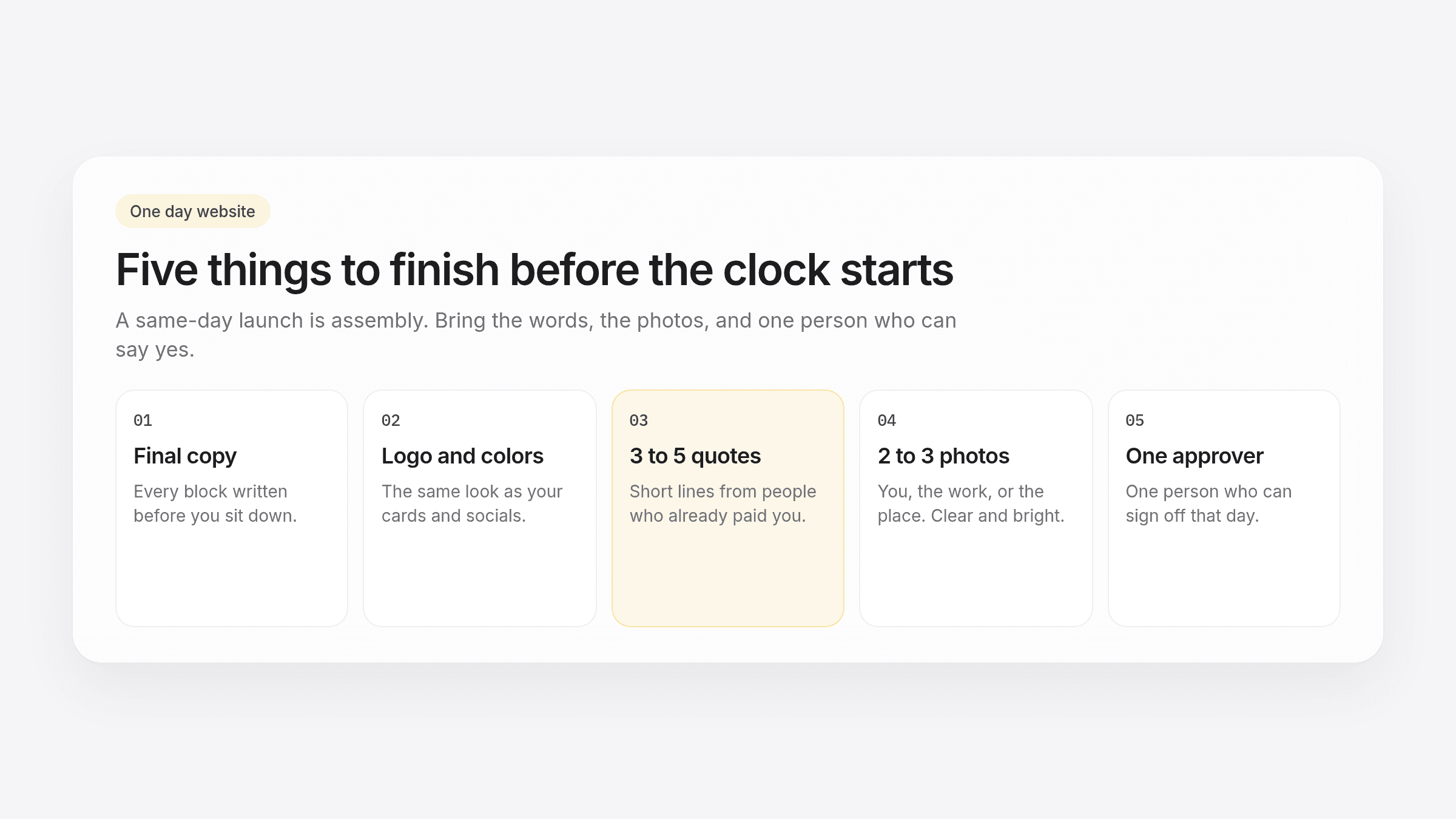
- Bring final words, logo and colors, 3 to 5 quotes, 2 to 3 photos, and the login for the shop that sold your name.
- Agency same-day fees vary by extras. OnePagey Free publishes on a OnePagey address. Annual Standard is $8.25/mo billed $99 with a .com.
- Photographers, trainers, plumbers, DJs, and pop-up launches fit a one-page offer with one next step.
You can get a professional one day website live today if you narrow the scope and show up with the content ready. Two paths get you there: a human-led VIP build day, or an AI one-page site you assemble yourself in minutes. Both work. The difference is who does the typing, and how much you finish before the clock starts.
This checklist is what decides whether the day ends with a live page or a pile of half-written drafts. For the five-minute publish path, see how to get a website online in 5 minutes. Timeline ranges live in how long it takes to build a small business website.

How does a one day website actually get built?
A one day website is a tight script. Every hour has a job. The schedule looks similar whether a designer or an AI system is doing the assembly.
Same-day shops typically run five phases: kickoff, content intake, build, review, and launch. One agency published the 24-hour cycle they use, from the first brief through go-live in a single sitting.
Here is what that looks like in practice:
- Kickoff (first hour). You confirm the goal, the one action you want visitors to take, and what belongs on the page.
- Assembly (bulk of the day). The page is built from your copy, photos, and colors, using a library of ready blocks so nothing is designed from a blank canvas.
- Review (afternoon). You look at a live draft and flag changes in real time instead of waiting for a revision round.
- Check and launch (final stretch). Links, the form, and the phone view get a pass, then the site goes live on your name.
A VIP day puts a designer next to you, adjusting as you talk. An AI website builder skips the back-and-forth: you describe the business, the system generates a page, and you edit it yourself. Prep still matters. It just moves who carries it.
What can you realistically get in one day?
Expect a focused, single-purpose site built around one goal: a call, a booking, or a buy. On a one-page site those pieces sit as blocks.
- A home block with the offer above the fold
- A services or product block
- A proof block with testimonials or results
- A contact or booking block with one clear next step
You should also leave with a layout that holds up on a phone, your colors and fonts applied, the name connected to the page, and basic search titles written. For what to put in each block, see what to put on a one-page business website.
Write the homepage around one action. A page trying to sell, book, and collect emails at the same time usually converts worse than one obvious next step.
What should you prepare before your build day?
Builders who finish the same day treat the day as assembly, not discovery. Front-load the content and lock the design calls so the clock is spent placing, not guessing.
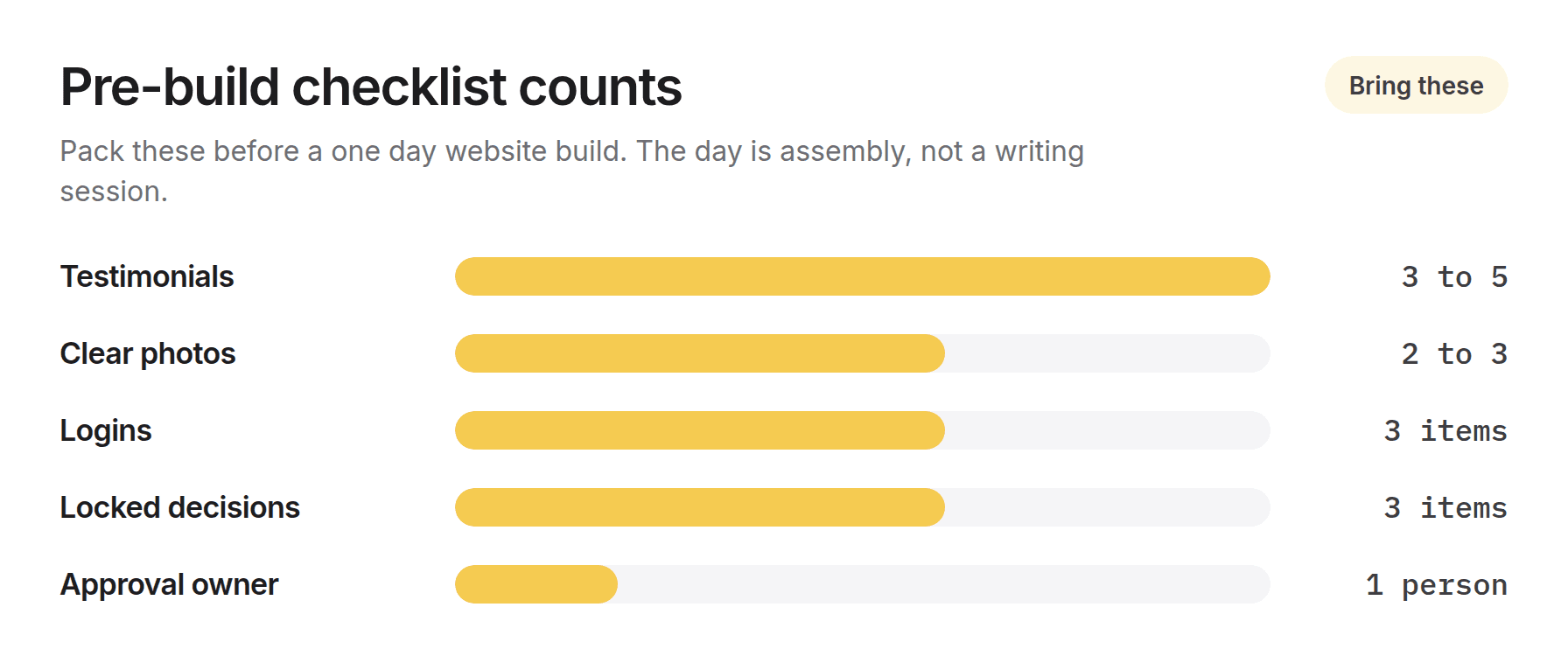
- Final copy for every planned block, not drafts you hope to polish live.
- Logo files and brand colors, plus any fonts you already use on cards or social posts.
- Three to five testimonials and two to three clear photos of you, the work, or the place.
- Logins: the shop that sold your domain, and any traffic tracker you already use.
- Locked decisions: the primary next step, a rough list of blocks, and one person who can approve changes that day.
Assign a single owner for approvals. Two people offering conflicting notes mid-build is the fastest way to lose an hour you do not have.
How much does a one-day website cost?
Fast-turnaround pricing usually lands in one of three shapes: a flat one-day fee for a fixed set of blocks, a tiered package, or a base fee plus hourly add-ons for anything outside the brief.
What moves the price:
- Extra blocks beyond offer, proof, and contact
- Custom photos or illustration versus the photos you already have
- Booking, payments, or a CRM hooked up on day one
- Copy written for you versus copy you bring yourself
On an agency build, hosting is often a separate monthly line. Ask what counts as an extra block, what a revision round includes, and whether hosting sits on the same invoice. OnePagey keeps the name, hosting, and page on one bill. Dollar ranges for other paths live in how much a small business website costs.
What quality checks should happen before you go live?
Speed only counts if the page works once it is live. Do a short quality pass before you share the link.
- Phone and form. Open the page on your phone. Tap every button. Send yourself a test message through the form.
- Titles and the share preview. Check the page title and the little card that appears when you paste the link in a text.
- Photos and alt text. Images should load cleanly and have a short description for people who cannot see them.
- The name. Confirm the page opens on the address you plan to print.
One agency's same-day case study reported the new page loaded in under two seconds and brought 22 calls within 48 hours. Treat that as proof a short timeline can still work, not a promise for every launch.
What happens after launch?
Going live is the start. Most shops leave a short window for urgent fixes, often within 72 hours, then a planned pass one to two weeks later once real visits show up.
Watch these numbers first:
- Calls, form submissions, or bookings
- How many people leave the home block without acting
- Whether the page still feels fast a week later
Small fixes usually go on a punch list. After that, you either edit the page yourself, pay for a managed plan with periodic updates, or buy hours when something larger comes up. OnePagey lets you edit the live page whenever the offer changes.
Which businesses fit a one day website?
A one day website fits when the business is simple to explain. A freelance photographer, a personal trainer, a local plumber, a wedding DJ, or a pop-up product launch all share the same shape: one offer, one audience, one next step. If the pitch fits in three sentences, a one-page site can carry it. The easiest way to get a small business online in 2026 walks that same path.
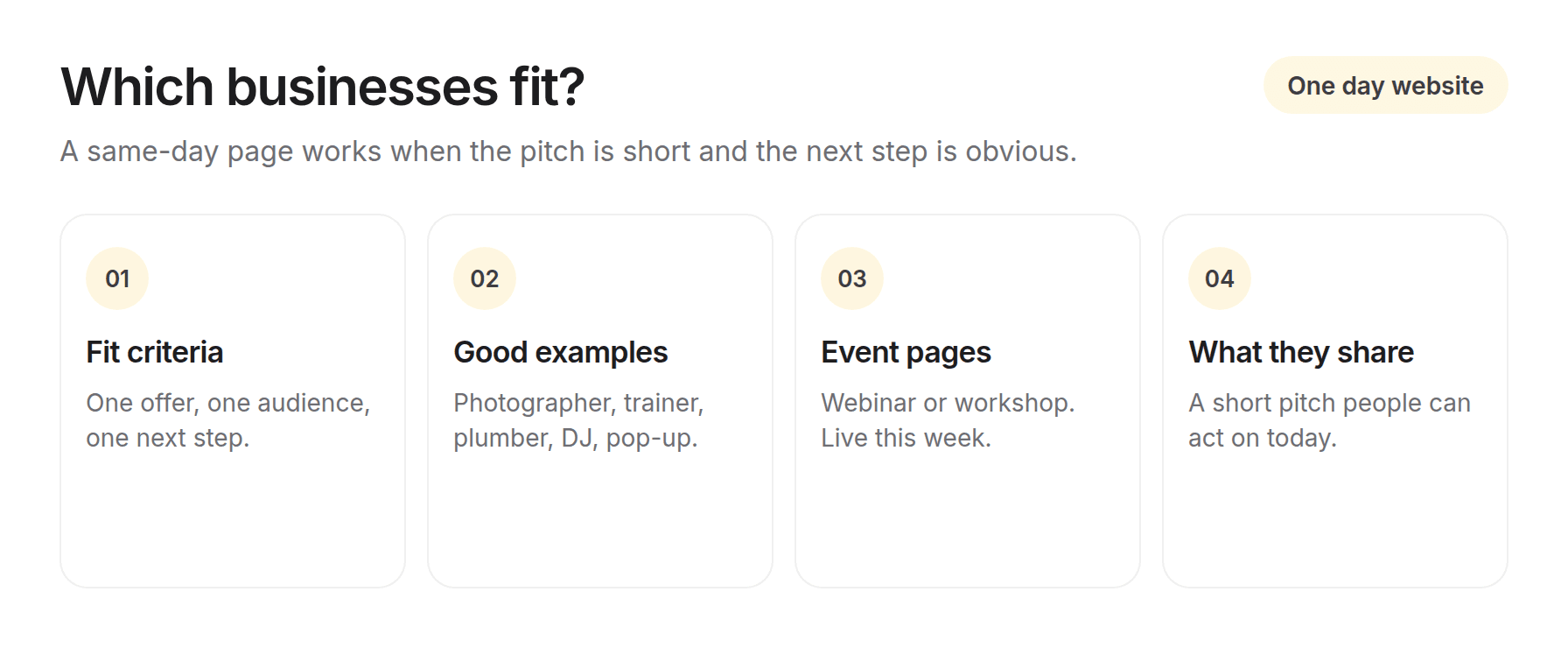
Event promotion is a strong fit too. A webinar signup or a one-time workshop needs to exist this week. A same-day page gets the date and the button in front of people while the tickets are still open.
Real estate agents, restaurants, and multi-practitioner offices often start with a live page the first day, then add booking, menus, or extra proof in a second pass once calls start.
When a one day website helps
Speed helps when the date cannot move: a product drop, a pop-up, or a new business that needs a URL on a card today. The useful test is whether your content, your decisions, and your approver are ready the morning of the build. If they are, book the day. If they are not, spend one more day writing copy first.
Get a one day website live with OnePagey
OnePagey is built for this clock. You describe the business in plain English, pick a .com, and get a one-page draft you can edit the same day.
You get a real domain, hosting, and a page you can change when the offer changes. That fits the same use cases that make a same-day build worth it: freelancers, local service providers, and launches that need a live page now. Browse real site examples or use cases by business type, then preview the page before you pay.
Free publishes on a OnePagey address. Annual Standard is $8.25/mo billed $99 with your .com included while you subscribe. Monthly Standard is $9.99/mo. Premium is $12/mo billed $144, or $14.49/mo, and adds business email.
Questions about plans or a name? Visit our support page. Real people reply within one business day.
Frequently Asked Questions
How much does a one-day website cost?
Agency same-day fees vary by scope: a flat day rate, a tiered package, or a base fee plus extras. OnePagey Free publishes on a OnePagey address. Annual Standard is $8.25/mo billed $99 with a .com and hosting while you subscribe. Premium is $12/mo billed $144 and adds business email.
What is a one-day website service?
It is a website build compressed into a single working day. You supply copy, images, and brand colors ahead of time so the day is spent on assembly and review. Some services use a designer working live with you. Others generate a page from a business description.
What can you actually get built in one day?
A focused page: an offer, a services or product block, proof, and a way to contact you, plus a phone-ready layout and basic search titles. Booking, payments, or extra proof can follow once the first page is live.
Are people happy with one-day website results?
Satisfaction tracks with preparation. People who arrive with final copy, images, and clear decisions leave with a finished page. Unprepared clients usually need another session to wrap the words.
Should I choose a VIP build day or an AI one-page site?
Book a VIP day if you want a designer in the room for a full day. Choose OnePagey if you want to describe the business, preview a one-page draft, and edit it yourself the same day.
Keep reading
More guides on getting a small business online.
- How to get your website online in 5 minutes
Get a website live today with an AI-powered builder, five pieces of content, and a publish button. Filter templates by industry, or skip templates if the builder generates the layout from your description.
- The easiest way to get your small business online in 2026
Customers still expect a .com when they search for you. See what a simple AI builder should do, why one page is enough, and how to go live with a .com this afternoon.
- How to write a business description for an AI website builder
AI website builders are only as good as your description. Use this short template so your generated homepage sounds like your real business.
One-page sites by use case
If you already know the kind of work you do, start on a page written for that job.