How long does it take to build a small business website?
By the OnePagey team7 min read
Summary
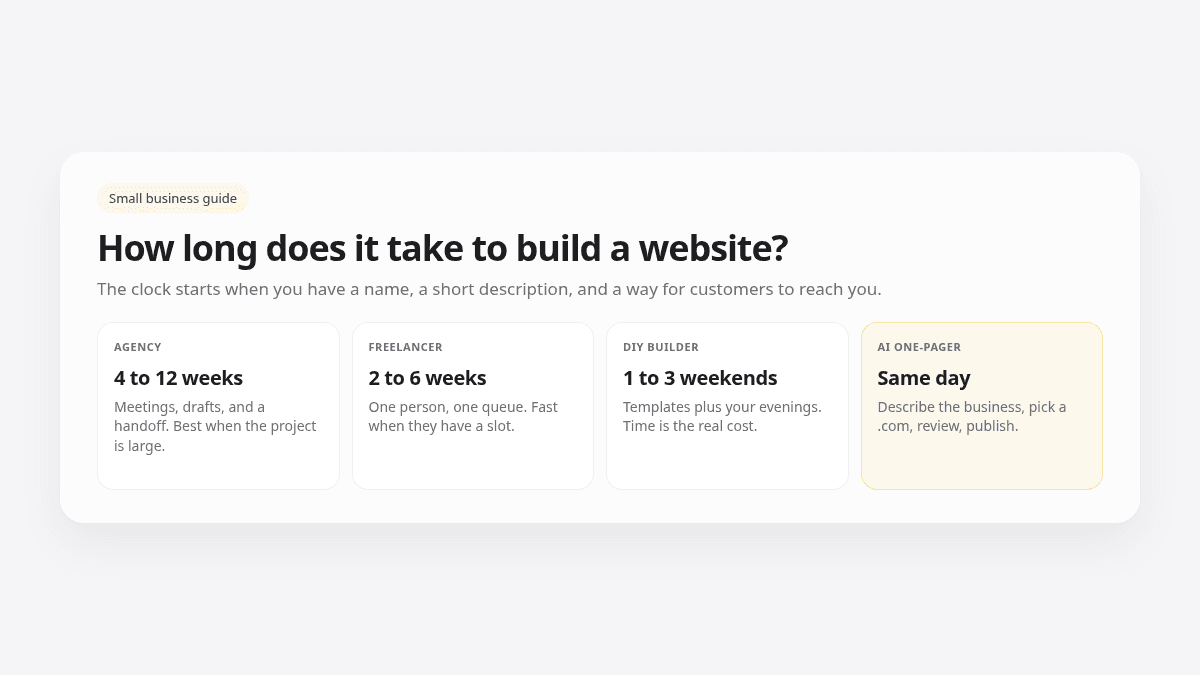
- How long to build a website depends on the path: agencies often take 4 to 12 weeks, freelancers 2 to 6 weeks, DIY builders a weekend or three, and an AI one-pager the same day.
- The usual delay is picking a name, writing a short description, and gathering a phone number and a photo.
- A one-week plan works for most local service businesses: name and .com on day one, copy on day two, photos on day three, review on day four, publish when it looks true.
- OnePagey drafts a one-page site from your description, then you pick a .com and publish with hosting included while you subscribe.
People type how long to build a website because a vendor quoted three months and a friend said they did it on a Saturday. Both quotes can be right. The date comes from which path you are on, and what you still need to decide.
A simple small-business page (who you are, what you do, how to reach you) can go live in a day. A custom brand system with a team of specialists takes weeks. Here are the ranges, the delays that eat the calendar, and a one-week launch you can follow.
For the five-minute version of the publish path, see how to get a website online in 5 minutes. If you are still weighing a hire, read whether you need a web designer. Dollar ranges live in how much a small business website costs.
What the timeline depends on
When someone says “it depends,” they usually mean one of these:
- How many people have to agree on the words and the look
- Whether you already have a name and a .com
- Whether someone else is in a queue before you
- How much of the page you still need to write
A builder can draft a page in minutes. A round of “let me think about the headline” can take two weeks. Count the decisions still open if you want a date you can trust.
How long to build a website, by path
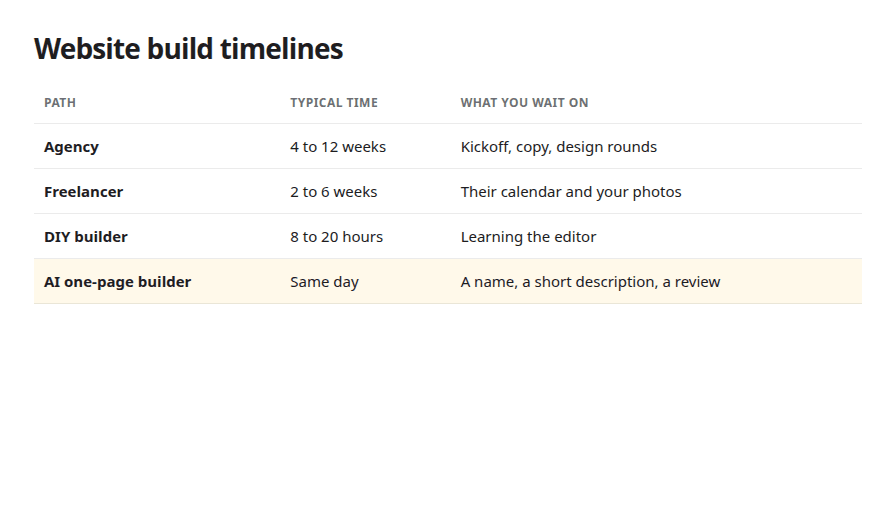
These ranges assume a simple small-business site: offer, proof, and a way to contact you. A one-page AI builder can finish that the same day. Agency and freelancer clocks run longer because more people have to agree.
Agency: 4 to 12 weeks
You are buying a process. Discovery calls, a first design, two or three revision rounds, then a handoff. That pace fits when several people have to sign off, or when the site is part of a larger brand project. A page customers can call from can use a shorter path.
Freelancer: 2 to 6 weeks
One person, one calendar. A good freelancer can be faster than an agency because there are fewer meetings. Their other clients and the days you spend gathering photos usually set the date. Ask when they can start.
DIY builder: 8 to 20 hours, often spread over weekends
Wix, Squarespace, and similar tools will let you drag a template around tonight. The hidden time is learning the editor, picking fonts, and fighting mobile layout. Plenty of owners finish. Some get stuck in the editor and leave a half-built page sitting for a month.
AI one-page builder: the same day
You describe the business in a few sentences. The builder drafts the page. You fix the phone number, swap a real photo, pick a .com, and publish. OnePagey is built for that loop. You get a one-page site, a real .com, a preview, then publish with hosting and themes included while you subscribe.
The same-day timeline holds when the description is specific. “Lawn care in Austin for busy homeowners, text us for a quote” drafts a useful page. “Quality and passion” leaves the builder guessing.
What slows owners down
These four stalls show up on every path.
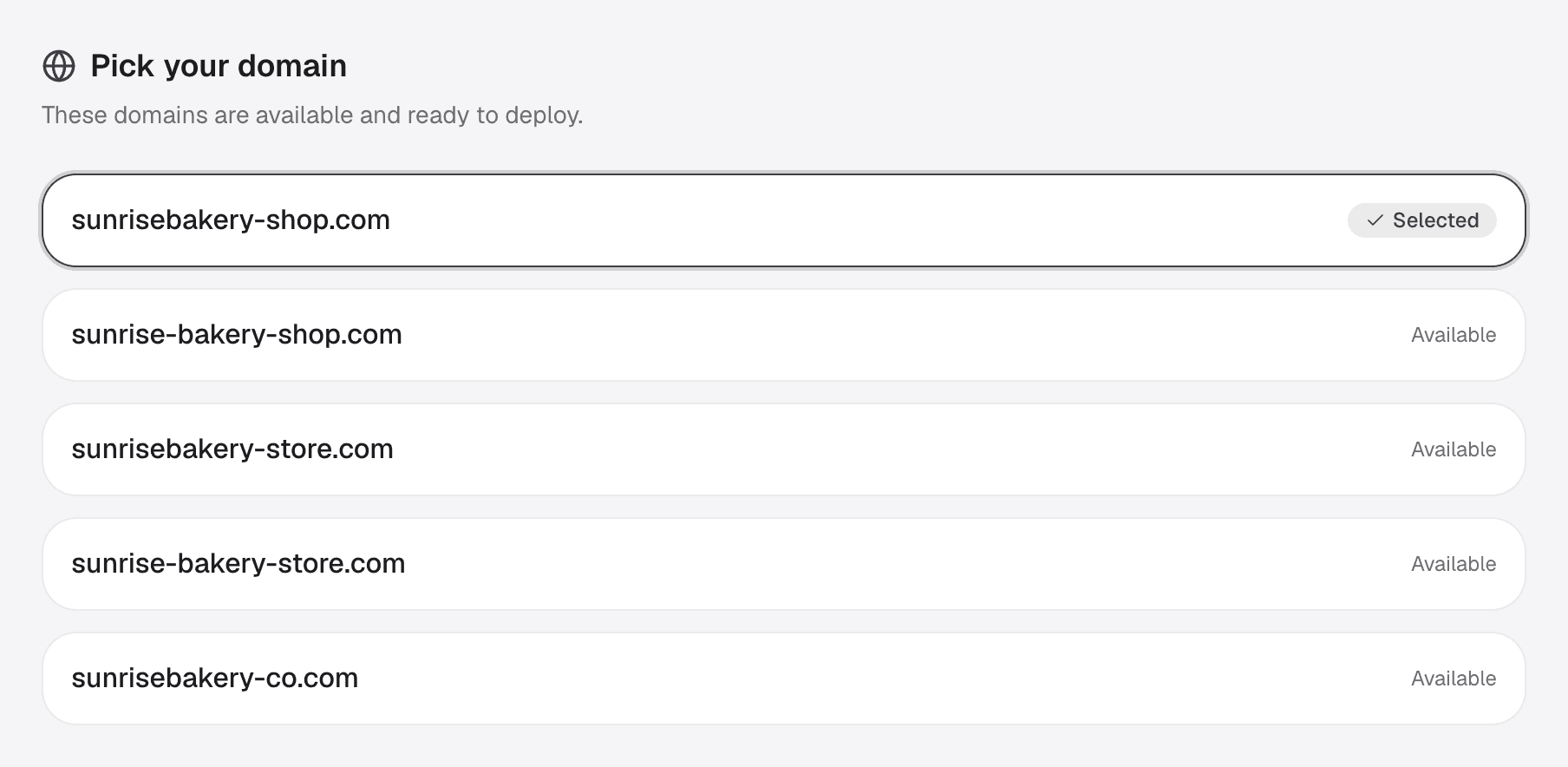
- No name, or a name with no .com. People fall in love with a phrase, then find the address is taken. Check availability before you print cards. The domain name generator looks up real .com names from what you do, then you can preview a page on the one you pick.
- A vague description. If you cannot say who you help in one breath, the homepage will stall. Write 40 to 80 words: the work, the customer, the area, the next step.
- Missing photos and a phone number. Stock images and a contact form nobody reads make a page feel unfinished. A cell number in the header is faster than a perfect gallery.
- Too many opinions. A spouse, a partner, and a cousin in marketing can add two weeks. Pick one person who can say yes.
A one-week launch plan
Use this plan to get a live page next week.
- Day 1: name and .com. Write the trade and city. Check a handful of .com names. Keep the one you can spell on the phone.
- Day 2: the description. Four short sentences. Who you help, where you work, what you do, what to do next (call, text, book).
- Day 3: proof. Two photos from a real job, plus hours or the towns you cover. A Google review you can quote is a bonus.
- Day 4: draft and edit. Generate the page. Fix anything that is not true. Put the phone number where a thumb can hit it.
- Day 5: publish. Go live. Send the link to three customers and ask if they would call.
If you want a feel for first-year cost while you wait on photos, open the website cost calculator. OnePagey annual Standard is $99 for the first year, with the .com included while you subscribe.
Keep reading
More guides on getting a small business online.
- What to put on your first business page after you file
Intro, About, Highlights, and Contact. That is the first page a new LLC can share the week the papers come back.
- From EIN to .com: simple path for new US small businesses
EIN in the folder. Next, a .com in your name and one page customers can open. Five steps from tax ID to a link you can text.
- Just formed your LLC? Domain + one-page site checklist
Papers are filed. People still ask for a link. Use this checklist for a .com in your name and a one-page site you can text.
One-page sites by use case
If you already know the kind of work you do, start on a page written for that job.