How much does a small business website cost in 2026?
By the OnePagey team8 min read
Summary
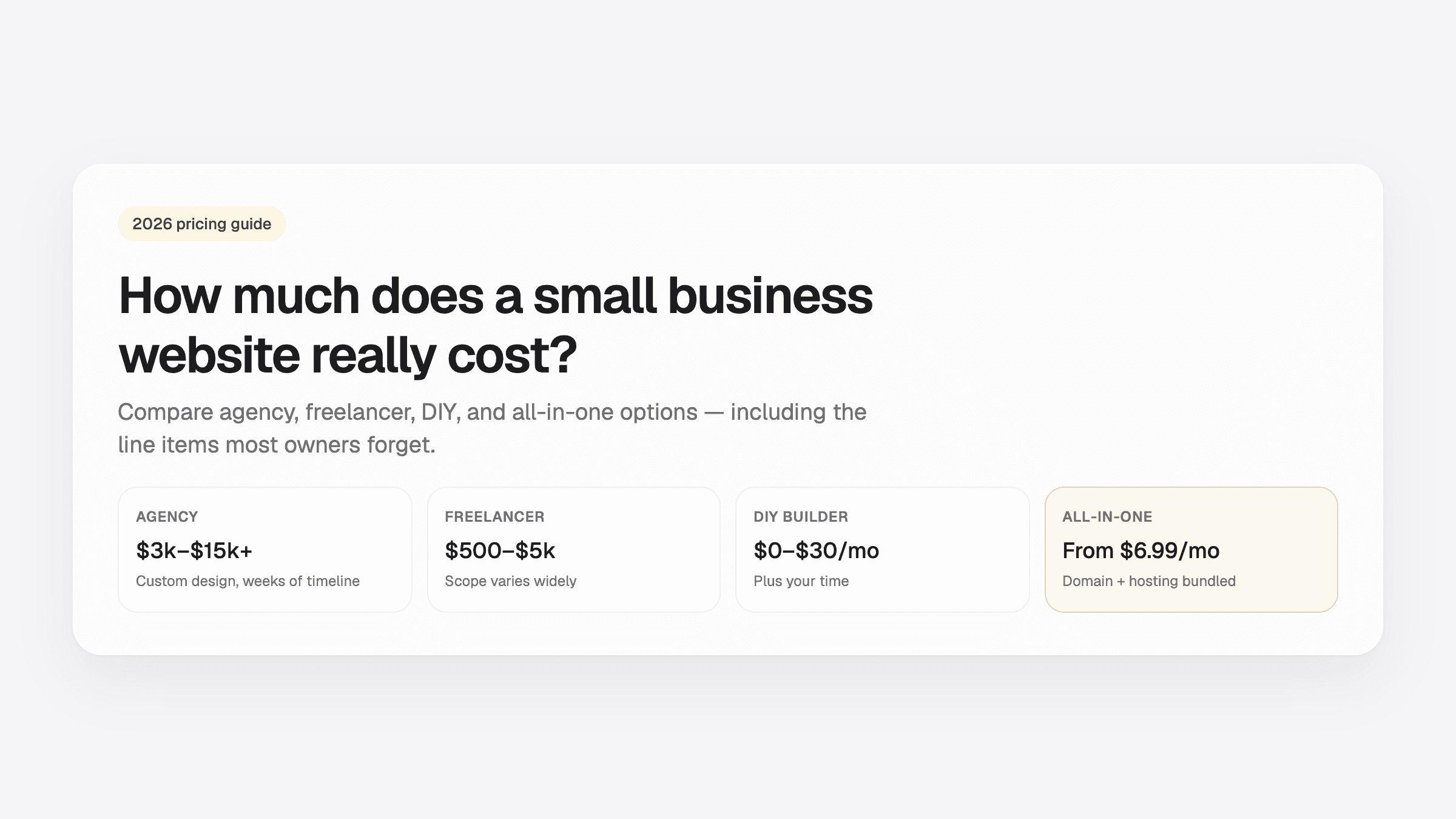
- DIY builders: expect about $0 to $30/month for a simple small business site.
- Freelancer builds typically run $500 to $5,000+; custom agency work $3,000 to $15,000+.
- Hidden costs like domain, hosting, maintenance, and your time often matter more than the sticker price.
- OnePagey is free to start. Standard with your .com and hosting is $99 a year.
Most owners ask the wrong question first: “How much does a website cost?” The better question is “What am I actually paying for, and what will I keep paying every year?”
A $500 freelancer quote and a $16/month builder plan are not the same product. One is a project. The other is a subscription. Agencies sell both design and peace of mind. DIY tools sell control at the cost of your Saturday afternoon, every few months.
Below are realistic 2026 price ranges for the four paths most small businesses consider, plus the costs people forget to budget, so you can match spend to how much time you want to spend.
The 4 Ways Small Businesses Get a Website (and What They Cost)
1. Hire a web design agency
Typical cost: $3,000 to $15,000+ one-time for a small business site; $50 to $300/month optional maintenance or retainer.
Agencies deliver custom design, strategy, copywriting (sometimes), and project management. You get a polished result without touching the tools yourself. The trade-off is price and timeline. Most agency projects take 4 to 12 weeks, not days.
Not sure if you need an agency at all? Read our guide on whether you need a web designer.
Best for: Established businesses with budget, complex branding needs, or a site that must support custom functionality (booking systems, member areas, large catalogs).
A local bakery, plumber, or consultant who needs one clear page live this week usually spends less with a builder.
Ongoing costs to budget:
- Hosting (often $15 to $50/mo if not bundled)
- Domain renewal ($10 to $15/year)
- Content updates (hourly or retainer)
- Security and plugin updates if the site runs on WordPress
2. Hire a freelancer
Typical cost: $500 to $5,000 for a small site; wide range based on experience and scope.
Freelancers sit between DIY and agencies. A solid one-page or small multi-page site from a competent freelancer often lands in the $800 to $2,500 range in 2026. You may get custom design, or a customized template. Clarify which before you sign.
For a deeper freelancer-and-agency breakdown (what drives quotes up, hidden fees to watch for, and questions to ask before you sign), see Paul Mulligan’s guide on what a small business website should cost in 2026.
If you are deciding between hiring and DIY, start with do you need a web designer for your small business website?.
Best for: Owners who want a human relationship and custom touches, but cannot justify agency fees.
Watch out for:
- Quotes that do not include hosting or domain setup
- “WordPress sites” that leave you managing updates yourself
- Scope creep. Every extra page adds cost
Ongoing costs: Same as the agency path: hosting, domain, and paid fixes when something breaks.
3. Build it yourself (Wix, Squarespace, Webflow, etc.)
Typical cost: $0 to $30/month for the builder; $10 to $20/month on common paid tiers.
DIY builders are the default for cost-conscious owners. Advertised prices often start around $16 to $23/month on annual billing for a plan that removes ads and includes a custom domain connection. Monthly billing costs more.
What the monthly fee usually covers:
- Hosting
- SSL certificate
- Templates and drag-and-drop editor
- Sometimes a free domain for year one (read the fine print on renewal)
What it usually does not cover:
- Your time. Plan 1 to 3 hours for a simple site if you are focused; longer if you are new
- Premium templates or apps (often $5 to $30/month extra)
- Professional copywriting or photography
- Separate domain renewal after promotional year one (about $10 to $20/year)
Best for: Owners who enjoy tinkering, want multi-page sites, or need builder-specific features (e-commerce tiers, scheduling apps).
Honest downside: The sticker price is low; the total cost of ownership includes subscriptions you keep paying, apps you add, and hours you spend. A “$15/month” site can become $40/month with add-ons. Still cheaper than an agency, but not trivial.
4. WordPress (self-hosted CMS)
Typical cost: $5 to $30/month hosting + $10 to $15/year domain + $0 to $200+ for themes/plugins; your time for setup and maintenance. For when WordPress fits a hosted builder, and when a builder is the simpler path, see our website builder vs WordPress guide.
WordPress itself is free. The bill comes from everything around it:
| Item | Typical 2026 cost |
|---|---|
| Shared hosting | $5 to $25/mo |
| Managed WordPress hosting | $15 to $50/mo |
| Domain | $10 to $15/yr |
| Premium theme (optional) | $30 to $80 one-time |
| Plugins (forms, SEO, security) | $0 to $200+/yr |
| Developer help when things break | $75 to $150/hr |
Best for: Sites that need a blog, many pages, memberships, or complex plugins, and an owner willing to learn or pay for upkeep.
WordPress is built for that stack. If you want a professional one-pager live before the weekend, setup (hosting, connecting the name, updates) is the extra work.
Hidden Costs Most Owners Miss
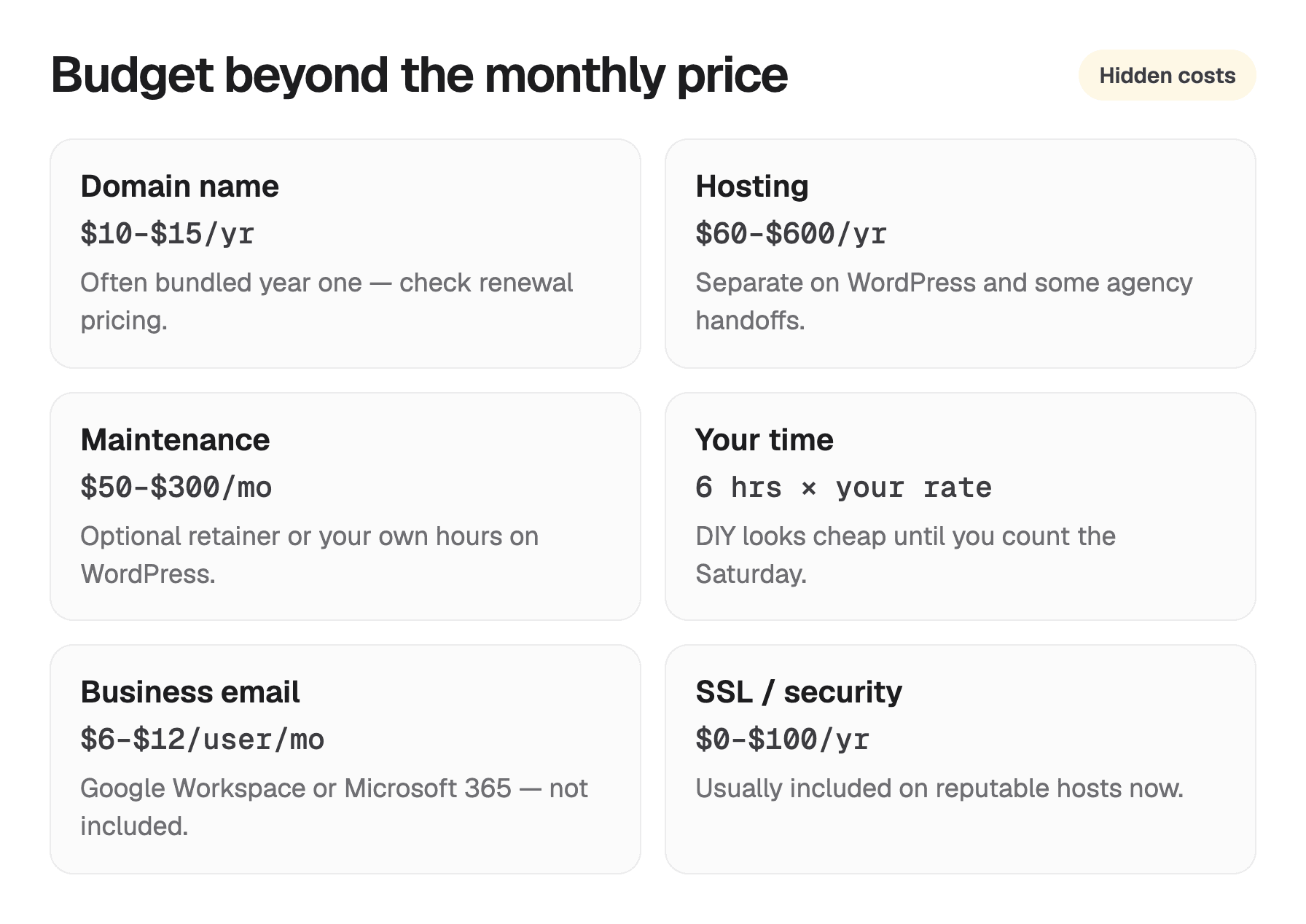
The platform price is never the full story. Before you compare options, account for these:
Domain name
$10 to $15/year on its own through a registrar. Some builders include it on annual plans; renewal pricing varies. See our guide on how to choose a domain name for your small business.
Hosting
Bundled in most builders and all-in-one products. Separate on WordPress and some agency handoffs, $60 to $600/year depending on quality.
SSL / security
Usually included now. If not, budget $0 to $100/year (most reputable hosts include free SSL).
Maintenance and updates
- DIY WordPress: 1 to 4 hours/month or paid help
- Builders: platform handles infrastructure; you still update content
- Agency/freelancer: optional retainer $50 to $300/month
Your time
If your billable hour is $75, spending six hours on a Wix site is a $450 invisible line item. That is not an argument against DIY. Just be honest in the comparison.
Email on your domain
A professional you@yourbusiness.com address often costs $6 to $12/user/month as a separate mailbox product (Google Workspace, Microsoft 365). OnePagey Premium includes business email on your .com, like hello@yourdomain, with the site and hosting on the same bill.
What Does a Simple Small Business Site Actually Need?
Most local and service businesses do not need a 20-page site on day one. They need:
- A clear headline (what you do, who you help)
- Contact details or a booking CTA
- Proof you are real (photo, short about, or reviews)
- A custom .com address
- Mobile-friendly layout
Those five items fit on one page.
If that sounds like you, paying agency rates for a massive custom build is usually overspending. If you need e-commerce for 200 SKUs, the math changes. You are not comparing the same category of product.
If you have not picked a platform yet, start with how to get your website online in 5 minutes, then come back here to sanity-check the budget.
All-in-One Options: When Bundled Pricing Wins
A newer category bundles generation, hosting, domain, and updates into one subscription. Fewer line items, and less technical setup.
OnePagey is built for this use case: one professional one-page site. Standard and Premium register a .com in your name, with hosting and click-to-edit updates. One checkout. The name is connected when you publish.
OnePagey pricing (2026)
Free, Standard, and Premium. Annual billing is two months free. Monthly is also available.
| Plan | Price | Billed |
|---|---|---|
| Free | $0 | Publish on a OnePagey address |
| Standard | $8.25/mo | $99 a year |
| Premium | $12/mo | $144 a year |
What each plan includes:
- One-page site, hosting, website templates, a OnePagey address, and dashboard edits on every plan
- Standard adds your own .com, registered in your name
- Premium adds business email on that .com, like hello@yourdomain
Domain and hosting stay on one bill on Standard and Premium. Monthly Standard is $9.99/mo. Premium monthly is $14.49/mo.
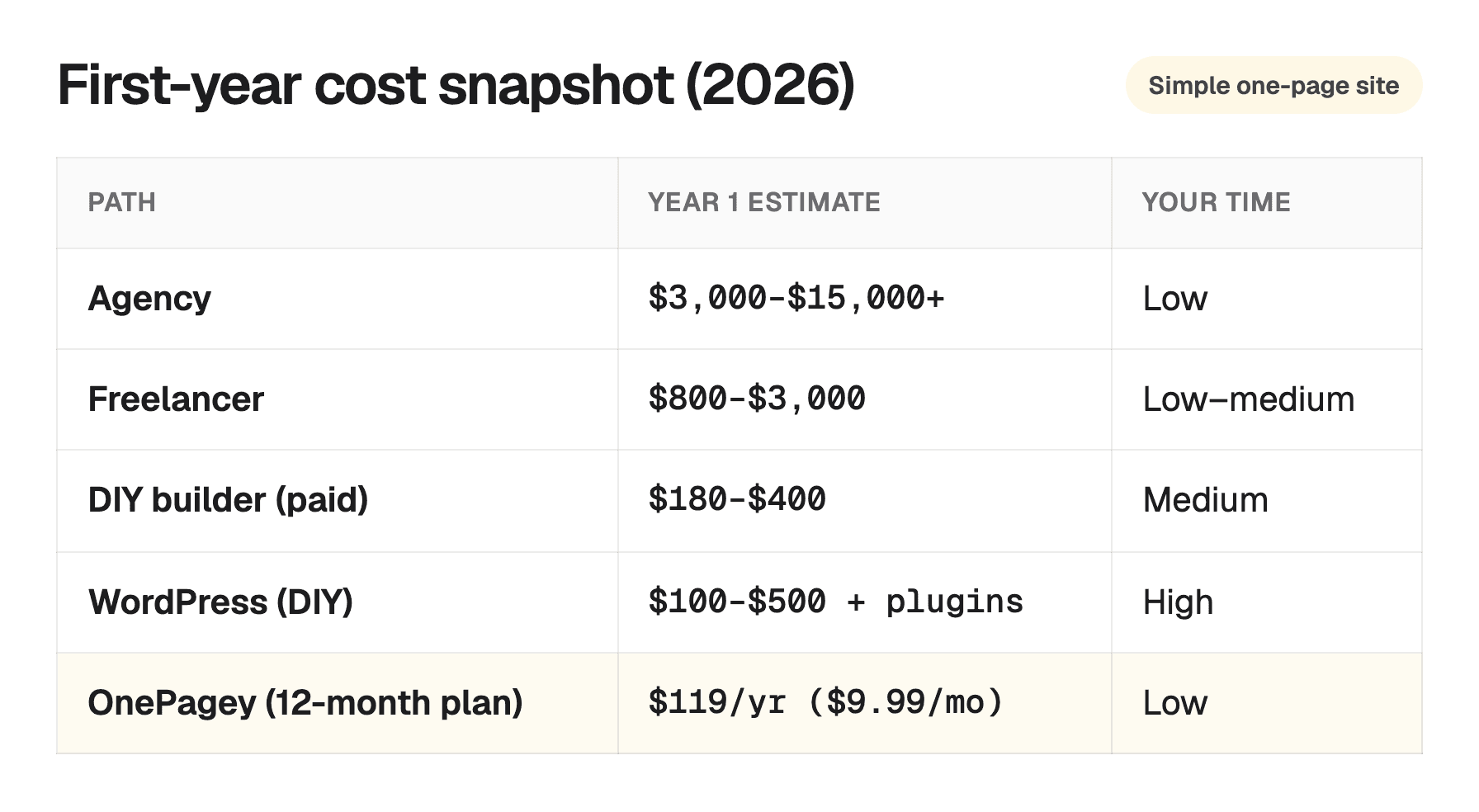
First-Year Cost Comparison (Simple One-Page Site)
Rough, honest ranges for a basic business presence, not enterprise e-commerce:
| Path | Year 1 estimate | Your time |
|---|---|---|
| Agency | $3,000 to $15,000+ | Low |
| Freelancer | $800 to $3,000 | Low to medium |
| DIY builder (paid) | $180 to $400 | Medium |
| WordPress (DIY) | $100 to $500 + plugins | High |
| OnePagey (Standard, billed yearly) | $99 ($8.25/mo) | Low |
These are ranges, not quotes. Your market, scope, and how much you do yourself will move the number. The point is to compare total first-year cost, not just the first monthly fee you see in an ad. OnePagey Standard billed yearly is $99 for the first year. Premium annual is $144 and includes business email on your .com.
How to Choose the Right Option for Your Budget
Use this quick decision tree:
Under $300/year and you are comfortable DIY?
→ Builder or WordPress on cheap hosting. Budget your time.
Under $300/year and you are not technical?
→ OnePagey. Free publishes on a OnePagey address. Standard bundles your .com and hosting, with the site generated for you.
$1,000 to $3,000 one-time budget and you want custom design?
→ Freelancer with a clear one-page scope in writing.
$5,000+ and branding is strategic?
→ Agency. Define deliverables, revisions, and who owns the site after launch.
Need it live this week?
→ Skip the agency RFP. Use an AI builder or a focused freelancer who specializes in fast launches.
Match spend to a simple site
A free subdomain (yourbusiness.wixsite.com) costs $0 and sends a clear signal: not fully established yet. For a hobby project, fine. For a business asking customers to pay you, a custom .com is worth the spend.
Similarly, the most expensive option is not automatically the best. A $10,000 agency site for a one-person consultancy is often $9,000 of features you will never use.
Match spend to scope. A simple business needs a simple site that is clear, credible, and live.
What Happens After Year One?
Websites are not a one-time purchase (except some freelancer handoffs where you truly own static files). Budget for:
- Renewal of hosting and domain
- Updates when your services, prices, or photos change
- Occasional fixes such as forms, broken links, and mobile quirks
OnePagey renewals follow the plan you chose. On Standard and Premium, the .com stays on the same bill while you subscribe. DIY and WordPress paths mean tracking hosting and the name as separate bills.
Also in this series: How to get your website online in 5 minutes · How to choose a domain name for your small business · What to put on a one-page business website · Website builder vs WordPress for small business · Do you need a web designer?
Keep reading
More guides on getting a small business online.
- Free website vs paid website for small business: what's worth it?
Free websites are fine for experiments. For a real business, the "free" version often costs trust. This is a free vs paid breakdown of ads, URLs, and what a paid .com buys.
- Website builder vs WordPress: which is right for your small business?
WordPress, Wix, or OnePagey? Compare setup, cost, and maintenance for small businesses, and learn when a one-page AI builder beats a full CMS.
- Wix vs Squarespace vs OnePagey for a simple business site
Wix and Squarespace are powerful, and easy to overbuy. See how they compare to a one-page AI builder when you only need a clear business presence.
One-page sites by use case
If you already know the kind of work you do, start on a page written for that job.