How to write a business description for an AI website builder
By the OnePagey team7 min read
Summary
- A good business description for a website is 2 to 4 short sentences covering what you do, who you help, where you operate (if local), one differentiator, and what visitors should do next.
- Skip vague slogans.
- AI website builders draft better homepages when your starting text is specific.
Most owners spend more time picking a template than writing the one paragraph that actually drives the result. With an AI website builder, that paragraph is the brief. Vague input produces vague headlines, generic About copy, and Highlights that could belong to any shop on the block.
Use this business description for website template, plus weak vs strong examples, so the model writes from facts instead of slogans.
Your description writes the headline
Templates decide layout. Your description decides meaning. An AI builder reads your words to invent a headline, About section, and selling points. If you write “passionate excellence,” you get motivational poster copy. If you write “same-day leak repair for Austin homeowners,” you get a page a customer can act on.
Think of the description as a phone script, not a brand manifesto. Say what you would tell a neighbor who asked what you do. That tone is usually clearer than marketing jargon, and it is exactly what AI tools need to stay grounded.
Once the draft exists, you still refine section by section. For how those pieces map on a one-page site, see what to put on a one-page business websiteIf you have not launched yet, pair this with how to get your website online in 5 minutes.
The five ingredients every good business description for a website needs
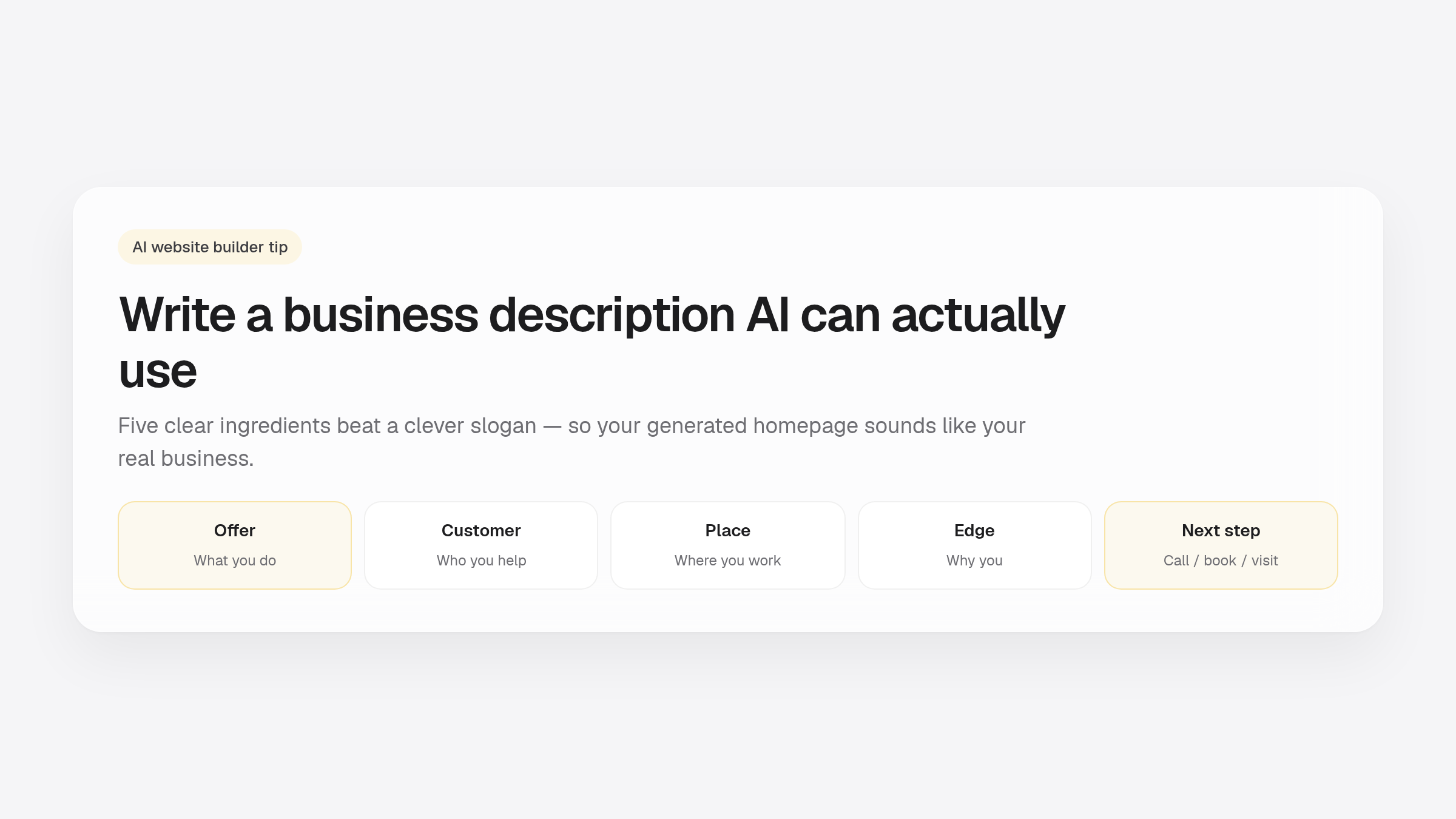
Cover these five ingredients in about 40 to 80 words. You do not need perfect prose. You need clear facts.
- Offer: the service or product in plain language (“residential plumbing,” “custom cakes,” “bookkeeping for freelancers”).
- Customer: who you help most (“homeowners,” “busy parents,” “local cafés”).
- Place: city, neighborhood, service area, or “online” if you are remote.
- Edge: one differentiator customers care about (same-day, family-owned since 1998, organic ingredients, bilingual support).
- Next step: call, book, visit, message, or shop.
If you only have room for three sentences, prioritize offer, customer, and next step. Location matters most for local search and trust. Price belongs here only when price is the main reason people choose you.
A fill-in template you can copy
Paste this into a notes app, fill the brackets, then tighten until it sounds like you talking:
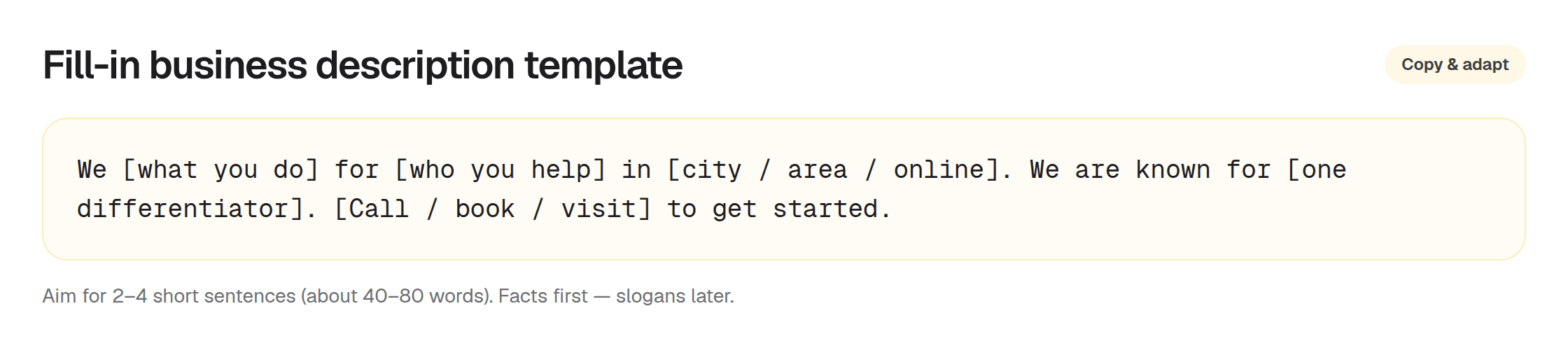
Example fill: “We bake custom cakes and weekend pastries for families in Portland. We are known for same-week orders and real butter frosting. Visit the shop or message us to order.”
That is enough for an AI website builder prompt. You can expand proof (reviews, years in business, certifications) later in About or Highlights, not in the opening description if it makes the paragraph muddy.
Examples: weak vs strong (local service + shop)
Weak descriptions sound inspiring and say almost nothing. Strong ones answer who, what, where, and what to do next.
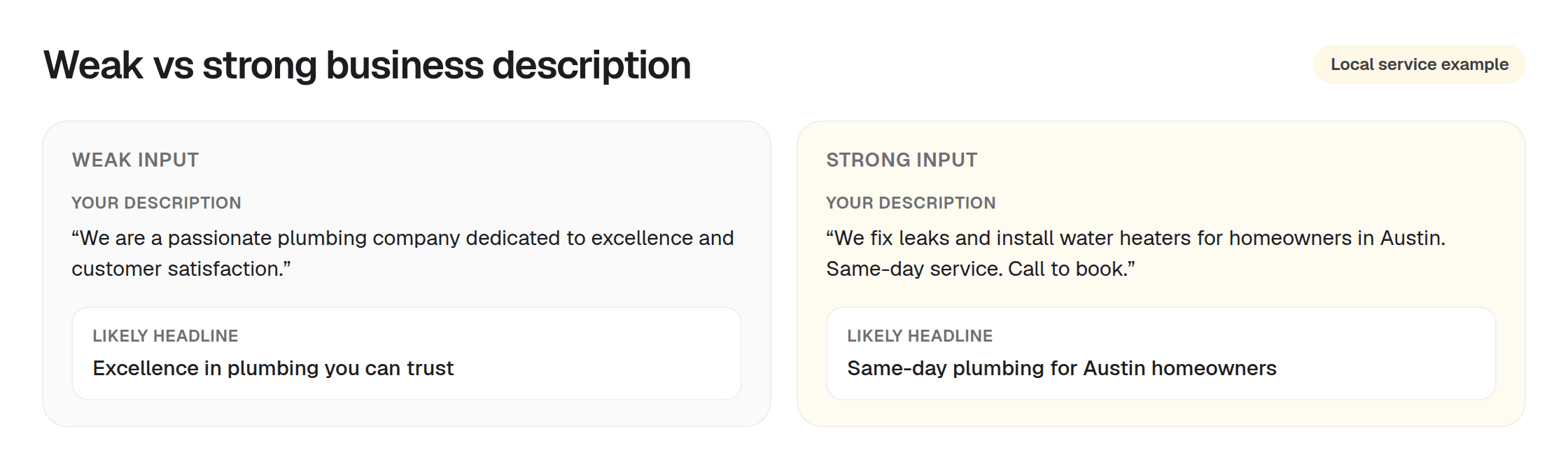
Local service
- Weak: “We are a passionate plumbing company dedicated to excellence and customer satisfaction.”
- Strong: “We fix leaks and install water heaters for homeowners in Austin. Same-day service when schedules allow. Call to book.”
Retail / shop
- Weak: “Your one-stop boutique for unique gifts and lifestyle products.”
- Strong: “We sell handmade ceramics and home gifts for shoppers in Brooklyn and online. Small-batch pieces from local makers. Visit the studio or shop the collection.”
Notice the strong versions still fit in a few sentences. They are briefs an AI (or a human designer) can use without guessing your trade.
What to leave out (and why AI gets confused)
AI tools fill gaps with plausible-sounding filler. If you omit facts, the model invents tone. If you add noise, the model amplifies the wrong theme. Leave these out of the starting description:
- Empty slogans: “excellence,” “passion,” “solutions,” “synergy” without a concrete service attached.
- Every service you might ever offer. List your core offer now; put the long menu in a Services section later.
- Internal history dumps. Founding stories belong in About once the page exists, not in the brief that generates the headline.
- Competitor bashing. Compare yourself with a positive differentiator instead.
- Keyword stuffing. Write for a human customer first; natural phrases like “how to describe your business for a website” happen when you are specific, not when you repeat SEO terms.
Also avoid contradictory claims (“luxury” and “cheapest in town” in the same breath). Pick the position you actually sell.
How OnePagey uses your description on Step 1
On OnePagey you enter a business name and short description before you choose a domain. That text powers domain suggestions and the generated one-page draft: Intro, About, Highlights, and Contact, which you review on Step 2. You do not need an account until you want to see the preview.
Better Step 1 description, clearer draft, less rewriting. Free publishes on a OnePagey address. Standard billed yearly is $99 with a .com included while you are subscribed. OnePagey is built for a focused one-page site: describe the business, preview, and publish.
Questions about what to write? Visit our support page. Real engineers reply within one business day.
Frequently Asked Questions
How long should a business description be for an AI website builder?
Aim for 2 to 4 short sentences (about 40 to 80 words). Cover what you do, who you serve, where you operate if relevant, and what you want visitors to do next. Longer bios can wait for the About section.
What should I include in a business description?
Include your offer, ideal customer, location or service area (for local businesses), one differentiator, and a clear next step such as call, book, or visit. Skip slogans that do not explain the work.
Can I use the same text for Google Business and my website?
Yes for the core facts: name, services, and area. On the website, expand slightly with proof and a clearer call to action. Keep name, address, and phone consistent everywhere.
What if I am not a good writer?
Write like you talk to a customer on the phone. Bullet the facts first, then turn them into sentences. AI builders draft the page copy; you only need a clear starting description.
Should I mention prices in the business description?
Only if price is a main reason people choose you (for example, transparent flat rates). Otherwise keep pricing for Highlights or Services and focus the description on who you help and how.
How does OnePagey use my business description?
On Step 1 you enter a business name and short description. OnePagey uses that to suggest .com domains and generate your one-page draft (Intro, About, Highlights, Contact) for review on Step 2.
Keep reading
More guides on getting a small business online.
- How long does it take to build a small business website?
Website timelines range from minutes to months. See realistic ranges by approach, and the bottlenecks that waste the most time.
- What to put on a plumber website
Leaks, towns, and a tap-to-call number. Use this checklist for a one-page plumber site, then preview a live Harborline example.
- What is an AI website builder? (and when to use one)
An AI website builder turns a plain-English description into a draft site. Learn how the generate, edit, and publish loop works, and when a human designer still helps.
One-page sites by use case
If you already know the kind of work you do, start on a page written for that job.