Free website vs paid website for small business: what's worth it?
By the OnePagey team8 min read
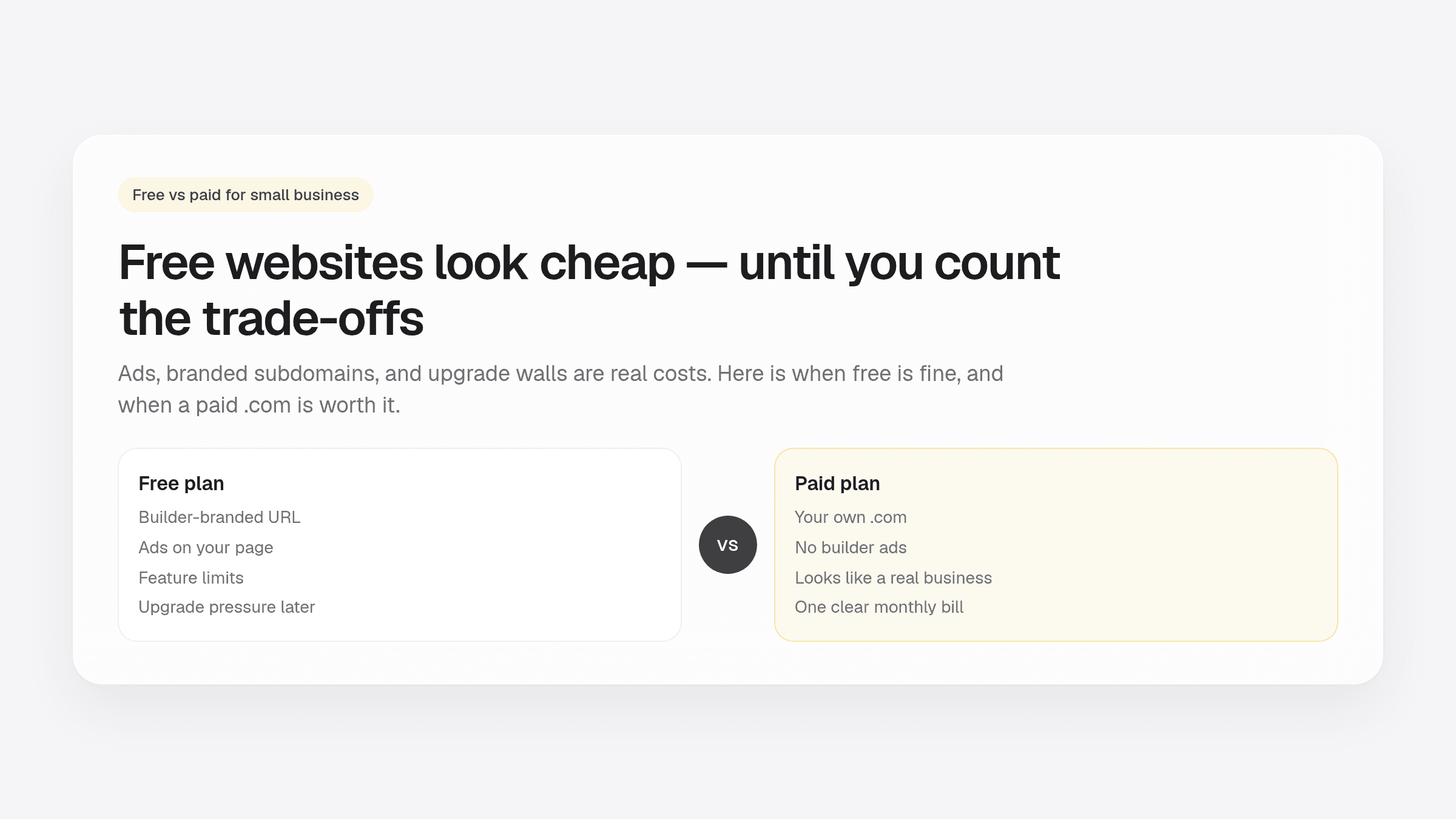
Summary
- Free website builders are fine for experiments. OnePagey Free is a real start on a OnePagey address. Standard is the .com customers remember.
- The real cost of free is often a branded subdomain, ads on your page, feature walls, and a painful migration later.
- A paid plan with your own .com usually costs less in trust than “$0” with someone else’s brand in the URL.
- OnePagey is free to start. Standard with your .com is $99 a year. Premium adds business email.
“Free” is the most tempting word in small-business software. A free website builder can get something on the internet tonight, and for a weekend experiment, that is genuinely useful.
For a real business, the free website vs paid small business decision is rarely about cash alone. It is about whether customers see your brand or the builder’s, whether ads compete with your call to action, and how much you will pay later to look legitimate.
Here is what free plans usually mean in 2026, when they are a reasonable experiment, when paid is the cheaper path, and a simple rule you can use without overthinking it.
What “free website” usually means in 2026
Most free website builders are freemium products. You get a template, an editor, and hosting, on their terms. In practice that often means:
- A branded subdomain like
yourshop.builder.cominstead ofyourshop.com - Platform ads or a sticky “Made with…” badge on your page
- Caps on pages, bandwidth, forms, ecommerce, or custom code
- Soft (or hard) pressure to upgrade when you want a custom domain, remove branding, or unlock basic features
None of that makes free builders “bad.” It makes them marketing funnels. The product you get at $0 is designed to prove value, then convert you to a paid website plan. That is fine if you go in with eyes open.
The real costs of free plans (ads, URLs, limits)
Cash cost can stay at zero for months. The costs that matter for a small business are softer, and they show up the moment a customer compares you to a competitor with a clean .com.
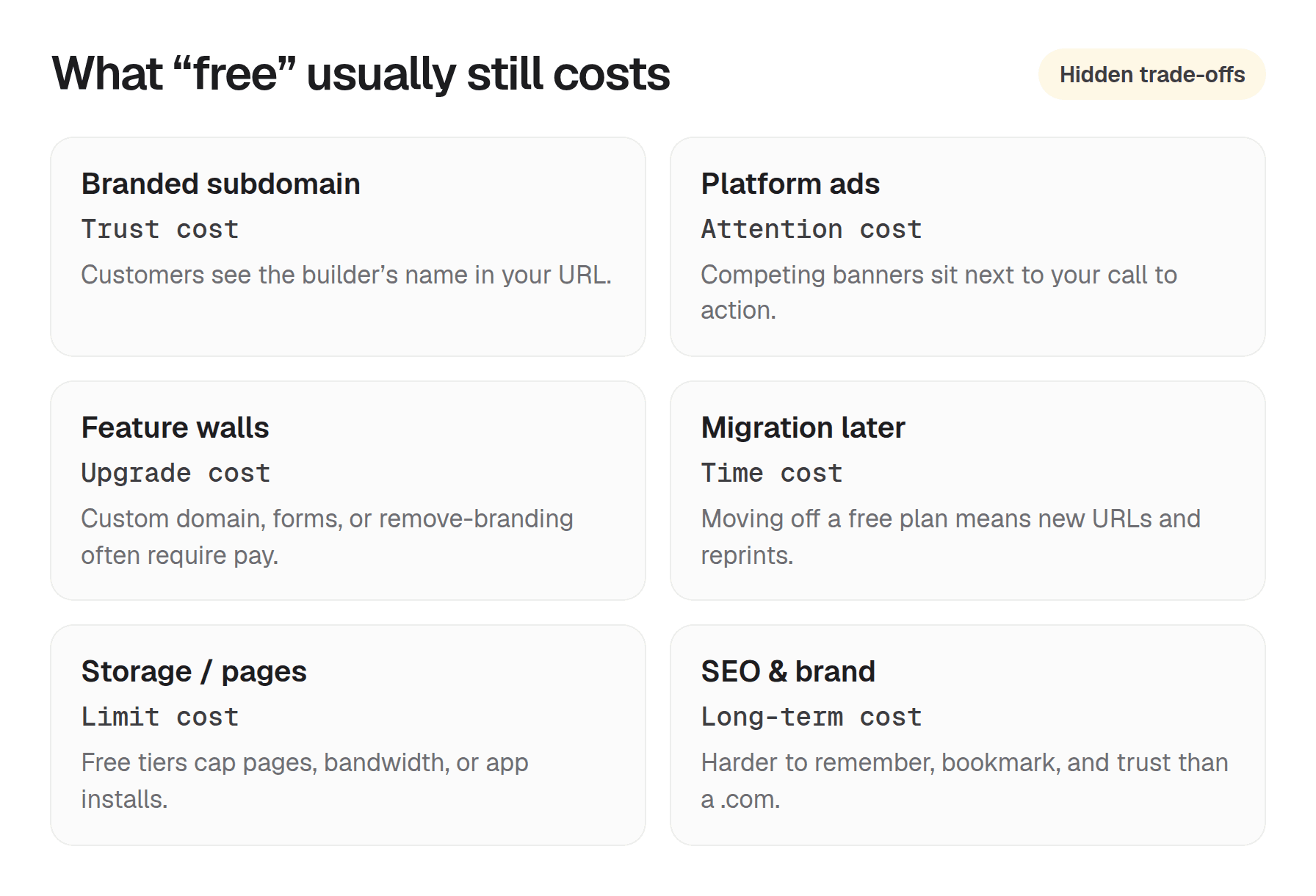
Branded URLs look unfinished
Customers type and remember brand names. A long subdomain trains them to remember the builder instead. It also signals “I have not invested in a real web presence yet,” even when your work is excellent. For how to pick a short, credible address, see how to choose a domain name for your business.
Ads steal the click you paid to earn
If someone finds you on Google or Instagram and lands on a page with someone else’s banner, that banner competes with your phone number and contact form. On a free website builder, you are often renting attention on your own homepage.
Limits show up right when you need the site
Need a booking form, a custom domain, or to remove branding before a trade show? That is usually the upgrade moment. Starting free and upgrading later works, but migrating content and changing URLs is annoying once your cards, Google Business Profile, and email signatures already point at the old address.
When free is actually fine
A free website builder is worth it when the site is not yet a sales tool:
- You are testing a side idea and do not want a card on file yet
- You need a temporary landing page for a class project, event, or internal demo
- You only need a placeholder while you finish naming the business
- Nobody is sending money, booking appointments, or judging legitimacy from the URL yet
If the site’s job is “prove the idea exists,” free is rational. If the site’s job is “make a stranger comfortable calling you,” paid is usually cheaper than looking unfinished.
When paid is the cheaper path to looking legit
Paid plans earn their keep when customers need proof you are real. Local services, shops with appointments, consultants, clinics, and anyone collecting deposits. A custom domain, HTTPS, and a page without builder ads are table stakes, not luxury.
Price-wise, many DIY builders land around $10 to $30/month once you remove ads and attach a domain. Some include a free domain for year one. Always check renewal. For full ranges across agency, freelancer, and DIY paths, read how much a small business website costs in 2026.
OnePagey Free is a real start: a one-page site on a OnePagey address, with hosting and edits from your dashboard. Standard is the .com customers remember, $99 a year, about $8.25 a month. Premium is $144 a year and includes business email on that .com, like hello@yourdomain.
Free vs paid comparison table
Use this as a quick scorecard when a free website builder pitch sounds too good:
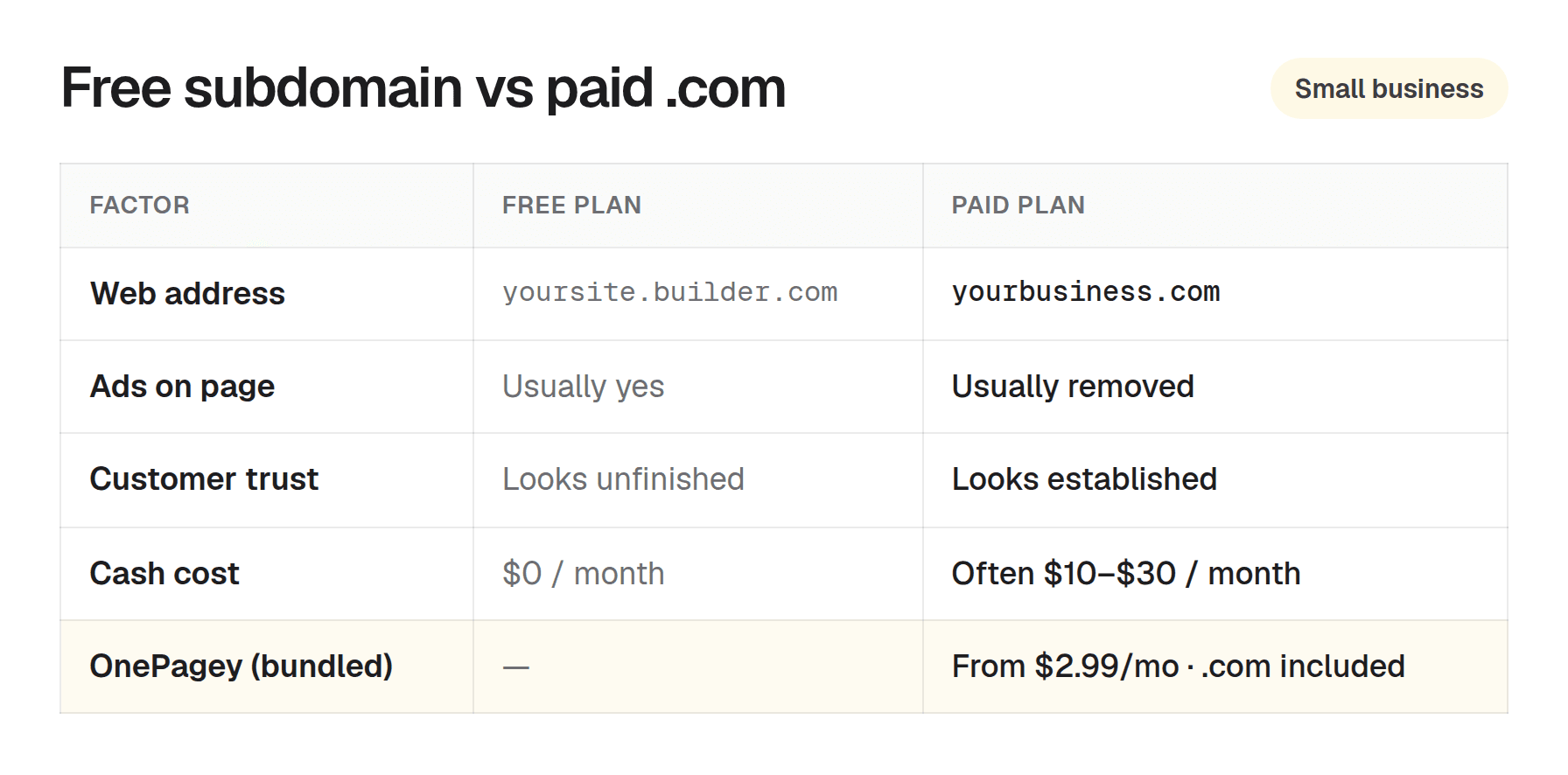
Notice the cash row favors free. Every other row that affects a sale usually favors paid. The real free website vs paid small business trade-off is experiment versus a page customers will judge.
A simple rule for small businesses
If customers need to trust you with money, time, or personal details, start paid with your own .com. If you are still deciding whether the business exists, stay free until the offer is clear, then migrate once, deliberately, to a branded domain.
Do not stay on a free subdomain for months “until things pick up.” The awkward URL is often one reason things do not pick up. Print materials, Google listings, and word-of-mouth all work better when the address matches the name on the door.
Questions about plans or domains? Visit our support page. Real engineers reply within one business day.
Frequently Asked Questions
Is a free website good enough for a small business?
It can work for testing an idea. For customers who need to trust you with money or appointments, a branded subdomain and ads often look unfinished. A paid plan with your own .com is usually worth it.
What are the downsides of free website builders?
Common downsides: builder-branded URLs, ads on your page, limited storage or features, harder custom domains, and pressure to upgrade later. Read the fine print on what happens when you leave.
Do paid website plans include a domain?
Sometimes for the first year only. Always check renewal price. OnePagey Standard and Premium include a .com while you are subscribed so domain and hosting stay in one bill.
How much should a small business pay for a website?
Many owners land between about $10 and $30 per month for a DIY builder, or more for freelancers and agencies. OnePagey Free publishes on a OnePagey address. Standard with your .com is $99 a year.
Can I start free and upgrade later?
Yes. OnePagey Free publishes a one-page site on a OnePagey address. Move to Standard when you want the .com customers will remember. That saves a rebrand of your web address later.
Will Google rank a free subdomain site?
It can index it, but branded subdomains are harder to trust and remember. A custom domain plus clear content is a stronger long-term SEO and brand choice.
Keep reading
More guides on getting a small business online.
- How much does a small business website cost in 2026?
Agency, freelancer, DIY, or all-in-one? Real 2026 price ranges for a small business website, including the costs most owners forget to budget.
- Website builder vs WordPress: which is right for your small business?
WordPress, Wix, or OnePagey? Compare setup, cost, and maintenance for small businesses, and learn when a one-page AI builder beats a full CMS.
- Wix vs Squarespace vs OnePagey for a simple business site
Wix and Squarespace are powerful, and easy to overbuy. See how they compare to a one-page AI builder when you only need a clear business presence.
One-page sites by use case
If you already know the kind of work you do, start on a page written for that job.