Do I need a custom domain for my small business?
By the OnePagey team7 min read
Summary
- A custom domain is an address you control, like yourbusiness.com, not a builder address such as yourbusiness.wixsite.com.
- A free subdomain is fine for demos. Switch to a custom .com before you print materials, run ads, or ask customers to find you.
- Buying a .com on its own is usually about $10 to $20 a year. Hosting and the website itself are extra if you buy everything separately.
- You do not have to set it all up yourself. Some builders register a .com and connect it to your site as part of the plan.
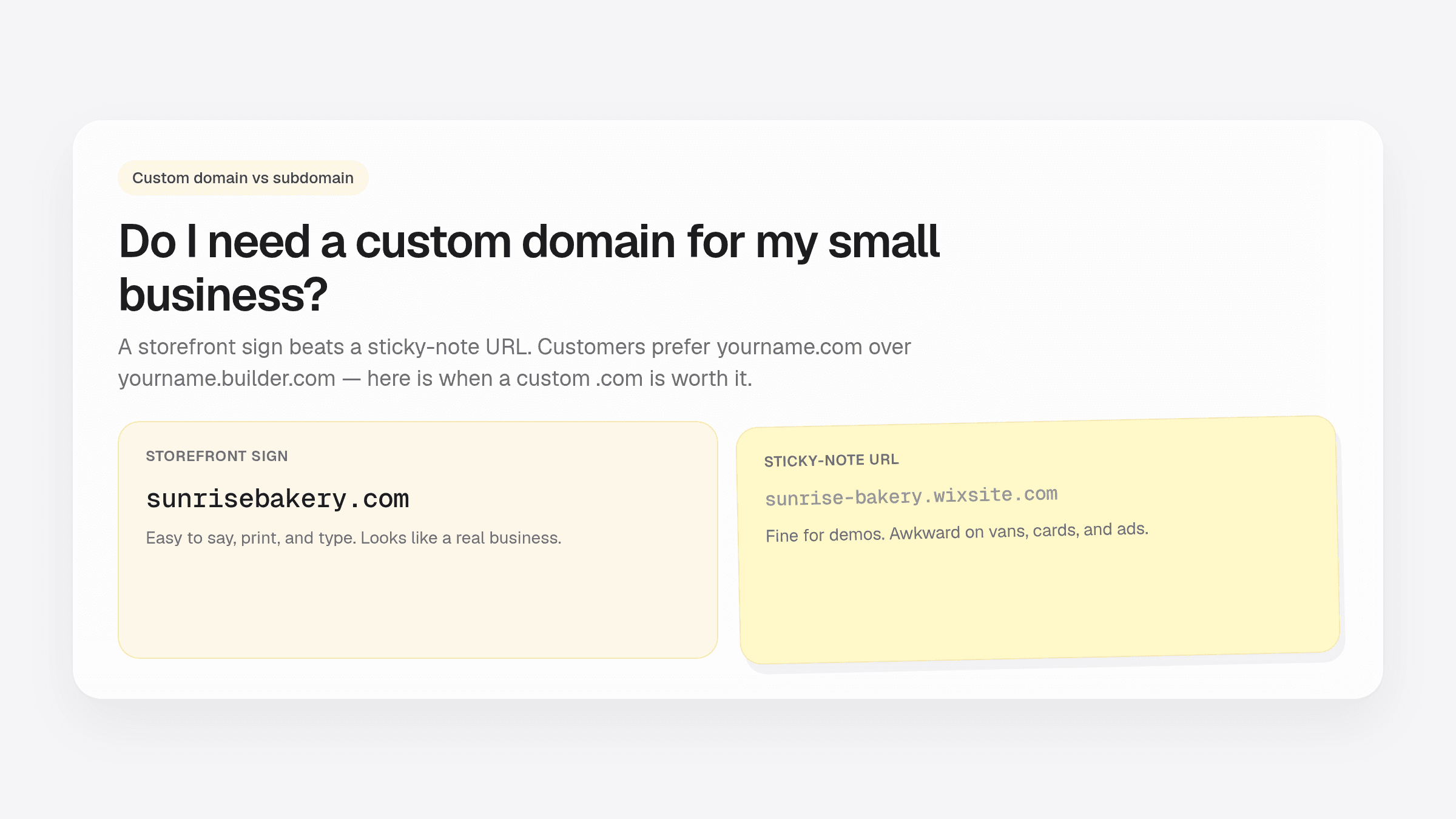
If you are asking do I need a custom domain, you are usually looking at two addresses that feel similar on a laptop and very different on a business card: yourbusiness.com versus yourbusiness.wixsite.com.
A platform address works for demos. Customers prefer yourname.com. Here is when a custom domain for a small business is worth buying, what a .com usually costs, and how to get one without a pile of extra setup.
Custom domain vs subdomain (plain English)
A custom domain is a web address you choose and keep, like sunrisebakery.com. Customers type it. It stays the same even if you later move your site.
A subdomain is an address the website tool lends you, like sunrise-bakery.wixsite.com or yoursite.myportfolio.com. You did not buy the part after the first dot. The tool’s name shows up in every link you share.
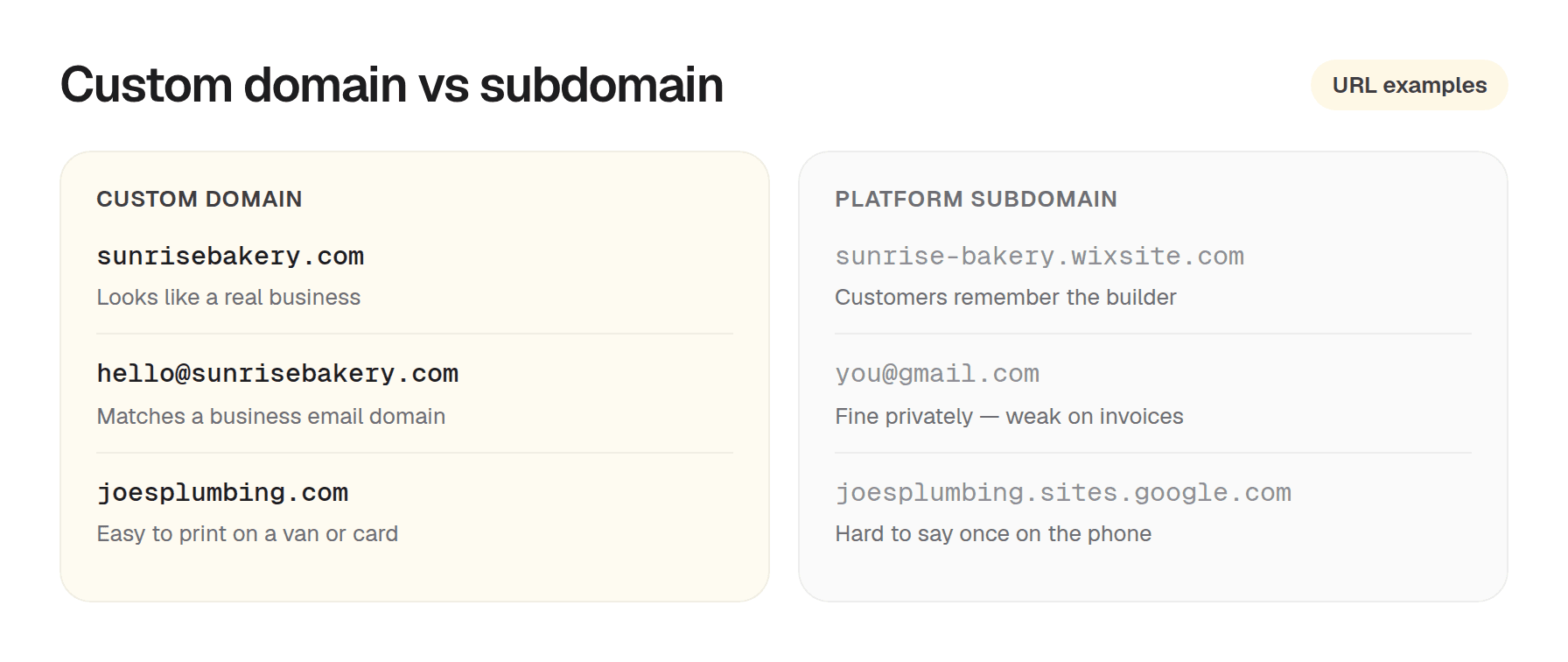
Subdomains are real websites. They just look unfinished when a customer is deciding whether to call you. People remember your business name, not the name of the website tool. For how to pick a short .com you can say out loud, see how to choose a domain name for your business.
Do I need a domain for my small business?
You can wait when the site is not yet how you get customers. A free subdomain is fine for:
- A private preview, just to see if the idea looks like a real site
- A class project, pop-up event, or weekend experiment
- A placeholder while you are still naming the business
Do not wait once strangers need to trust you. Get a custom domain before you:
- Print cards, menus, van wraps, or window vinyl
- Run ads or put the URL in an Instagram bio customers will tap
- Ask people to book, pay a deposit, or email you from the site
- List the address on Google Business Profile
Changing addresses later is a hassle. Every old link, QR code, and listing has to move. If you already know this is a real business, buy a .com domain on day one and skip reprinting your web address.
Credibility, email, and print materials
A custom domain does three jobs a borrowed address cannot do well.
It looks established
joesplumbing.com reads as a business. joesplumbing.sites.google.com reads as a project. Customers decide in seconds whether to call. The URL is part of that first impression, especially next to a competitor with a clean .com.
It makes a matching business email possible
hello@sunrisebakery.com looks more professional on invoices and quotes than a personal Gmail. A custom domain is what lets you use a business email domain that matches your brand. Own the name first, then you can send mail as @yourbrand.com.
It survives print
Long borrowed addresses wrap badly on a van, a receipt, and a radio ad. If you have to spell “wixsite” out loud, you will lose people. A short .com is the version you can say once.
What a .com usually costs
If you buy a .com on its own in 2026, it is typically about $10 to $20 per year. First-year sale prices can look cheaper. The renewal price is the one that matters.
That fee is only the name. The website and hosting are separate if you buy each piece from a different company. Many website tools include a domain for year one on an annual plan, then charge $10 to $20 to renew the name on top of hosting. Add those lines up before you celebrate a “free domain.”
OnePagey Standard includes a .com while you are subscribed, so the domain and hosting stay on one bill. Standard billed yearly is $99, about $8.25 a month. Monthly Standard is $9.99/mo. Free publishes on a OnePagey address if you want a first page before the .com. For the full website budget, see how much a small business website costs in 2026.
How to buy a .com domain without the extra work
The usual way to buy a .com domain looks like this:
- Search names until you find one that is available
- Pay for the name and turn on auto-renew so you do not lose it
- Sign up for a separate website host
- Connect the name to the site, then wait for it to go live
- Fix leftover details if the address still does not load cleanly
None of that is impossible. It is a lot of tabs for an owner who just wants a page that says what they do and how to call them. A simpler path: use a builder that checks availability while you set up, registers the name, and points it at your site for you.
That is still a real custom domain in your name. You skip the Sunday night scavenger hunt. Once the name is set, the rest of launch is content, preview, and publish. Our 5-minute website guide walks through that sequence.
How OnePagey handles domain + site together
OnePagey is built for owners who want one professional page and a .com, without bouncing between extra accounts:
- On Step 1 you enter a business name and short description. Available .com suggestions appear in the same flow.
- You can search a custom name if the suggestions are not quite right.
- After payment, a short form on the dashboard lets OnePagey register and connect the domain while you are subscribed. The domain is registered in your name.
If you cancel, hosting goes offline at the end of the paid period and automatic domain renewal stops. The name stays registered to you, and you can move it before it expires. Details are in our Terms. Read that before you buy so there are no surprises. If you want one clear page, a custom .com, and hosting on a single bill, that is the path OnePagey is built for.
Questions about domains or plans? Visit our support page. Real people reply within one business day.
Frequently Asked Questions
Do I need a domain for my small business?
Yes, once customers need to find you, trust you, or print your web address. A free subdomain is fine for a private preview. A custom .com is the version you put on cards, ads, and Google Business.
What is a custom domain?
A custom domain is a web address you own or control, like yourbusiness.com, instead of a platform address such as yourbusiness.wixsite.com.
Do I need a .com or will another ending work?
For most small businesses selling to a general audience, .com is still the default people type and trust. Other endings can work for specific brands, but .com remains the safest default.
Can I use a free subdomain temporarily?
Yes for internal previews. Switch to a custom domain before you print materials, run ads, or ask customers to find you online.
Does a custom domain help SEO?
A clear, memorable domain helps people click and remember you more than stuffing keywords into the URL. What you write, how fast the page loads, and how relevant you are locally matter more for rankings once you are live.
How do I connect a domain to my website?
The usual way is to buy the name from one company and then connect it to whatever hosts your site. With OnePagey, available .com suggestions appear while you set up, and the domain is registered and connected as part of your plan while you are subscribed.
What happens to my domain if I cancel?
Policies vary by platform, so read the terms. OnePagey’s terms explain what happens to the domain and hosting when a subscription ends. Review them before you buy so there are no surprises.
Keep reading
More guides on getting a small business online.
- How to choose a domain name for your small business
Your domain is the sign above the door. Learn seven rules to pick a short, credible .com, skip common mistakes, and check what is actually available in under ten minutes.
- Domain costs for U.S. small businesses: avoid a 5 to 10x renewal jump
A $2 first-year .com can renew at $22. See typical U.S. prices by ending, the fees people miss, and how to compare year two before you buy.
- Just formed your LLC? Domain + one-page site checklist
Papers are filed. People still ask for a link. Use this checklist for a .com in your name and a one-page site you can text.
One-page sites by use case
If you already know the kind of work you do, start on a page written for that job.