Domain costs for U.S. small businesses: avoid a 5 to 10x renewal jump
By the OnePagey team8 min read
Summary
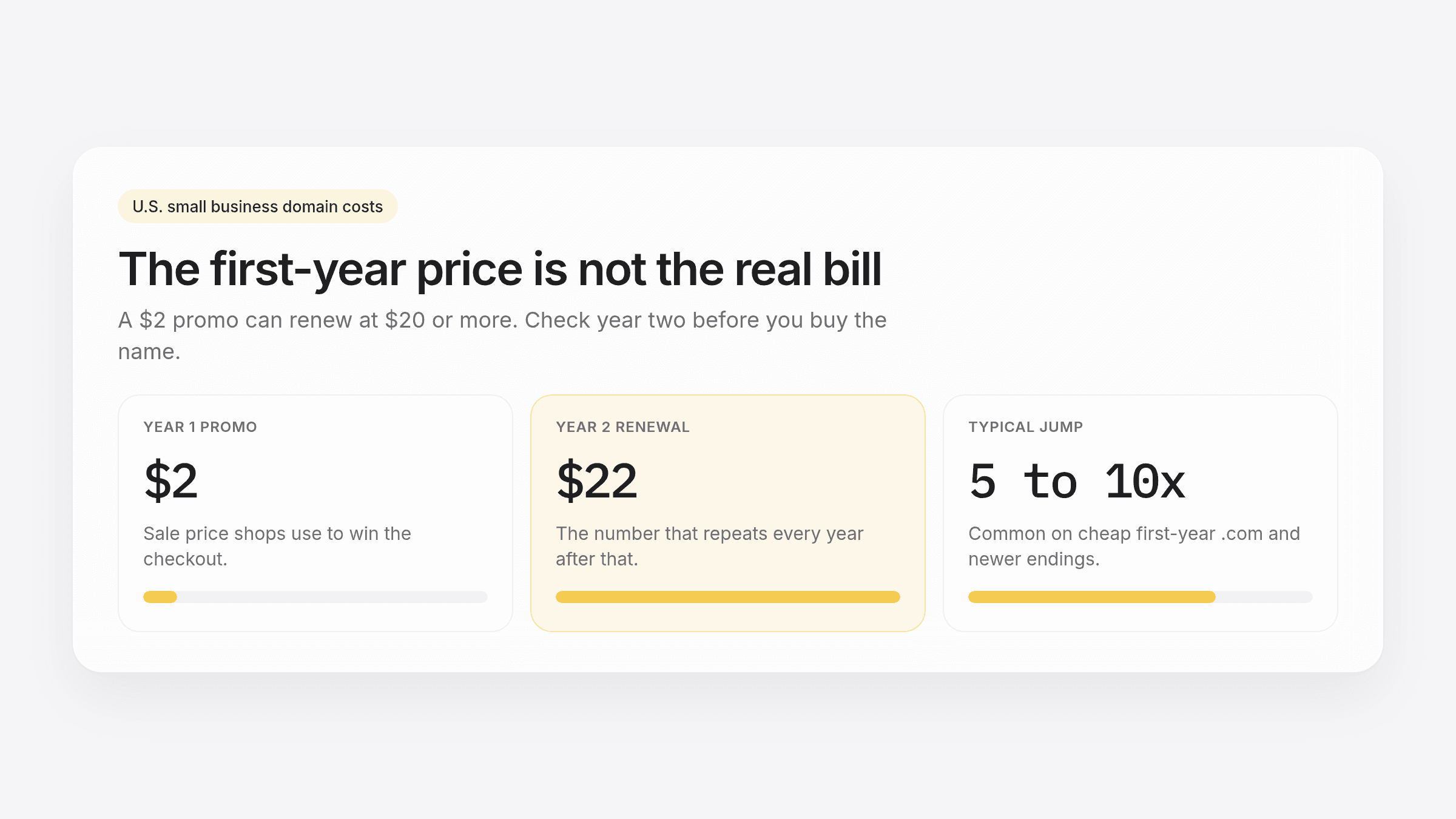
- A standard .com, .net, or .org usually costs $10 to $20 a year after the first year. The cheap checkout price is often a promo.
- Newer endings like .xyz or .site can start at $1 to $2, then jump to $15 to $35 at renewal. That 5 to 10x jump is the usual surprise.
- Premium names stay expensive every year. A resale name is often a large one-time payment, then a normal yearly bill.
- Budget extra for privacy, email, transfers, and a reclaim fee if the name expires. Compare year-two prices before you buy.
- OnePagey searches and registers a .com, hosts the page, and publishes a one-page site from a short description on one bill.
Most U.S. small businesses pay about $10 to $20 a year for a standard .com, .net, or .org. That first-year number is often a sale price. Domain costs for U.S. small businesses jump when renewal hits, especially on newer endings and names marked as premium.
The ending you pick, whether the name is flagged as premium, and which shop you buy from drive the swing. A $2 checkout can turn into a $20 yearly bill. That is the trap this guide is about.
How much do domain costs run by extension?
The ending changes the price more than almost anything else. Here is what U.S. owners typically pay for a standard name, not a premium one:
- .com usually $10 to $20 per year at renewal, sometimes under $5 as a first-year promo
- .net and .org similar to .com, often $12 to $20 per year
- .xyz, .site, .online often $1 to $2 for year one, then $15 to $35 at renewal
- .shop often cheap up front, with renewals closer to $30 to $40
- .us generally $8 to $15 per year, a steadier U.S. option
That gap between the sale price and the renewal is the surprise buyers report most. Cloudflare notes that standard names can run about $10 to $12 a year, while the same company's premium inventory sells for far more. Icon.com sold for $12 million in 2025. That is an outlier, not a budget. It shows how wide the range gets once you leave a normal registration.
Before you take a $0.99 first-year deal, search that shop's own renewal list. Most publish it. The jump from promo to renewal is often 5 to 10 times higher.
Newer endings like .xyz or .site look cheap because the companies that run them price year one to get more people to try the ending. Your year-three budget still has to pay the reset price once the promo ends.
Why do domain prices vary so much?
Two companies set the price, and most buyers only see one of them. The company that runs the ending (Verisign runs .com) sets a wholesale number. The shop you buy from adds its markup, support costs, and sale prices on top.
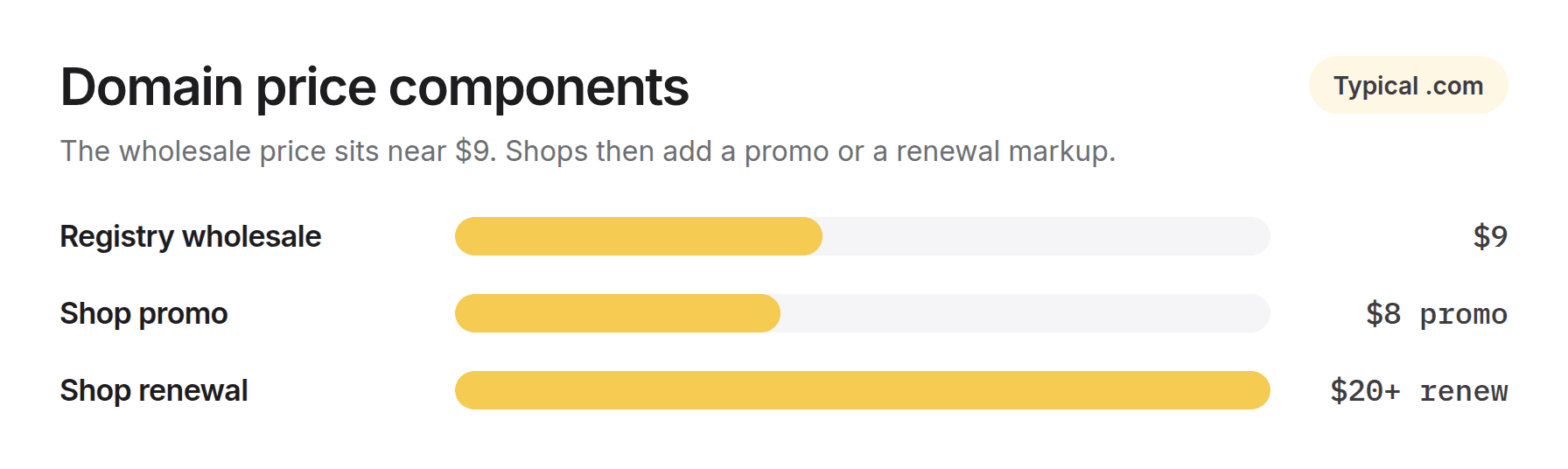
That split explains a lot of the confusion. Wholesale on a .com might sit near $9 a year. The shop then prices it at $8 as a loss-leading promo, or $20 and up once renewal starts, depending on what else it bundles. Upwork groups domain spending into registration, premium purchases, and ongoing overhead, and treats a domain as a yearly lease, not a one-time buy.
Some names are also marked registry-premium. Short, generic, or high-traffic words get a higher wholesale price from day one. That status usually stays for the life of the name. Every renewal costs that same higher rate.
A few things to watch when you compare shops:
- Some advertise a low registration fee, then charge extra to connect the name to your site.
- A transfer usually adds one year to the term, at the new shop's standard rate.
- Some shops publish the renewal number in plain sight. Others hide it behind “current market rates.”
Ask what the name will cost in year two, in writing. If they hedge, treat that as a reason to keep shopping.
What extra fees should you budget for?
The advertised registration price is rarely the full bill. These lines show up often:
- Privacy that hides your home address. Many shops now include this for the life of the name. Others charge $5 to $15 a year. Confirm which camp you are in before you pay.
- Connecting the name to your site. Basic setup is usually free. Faster or extra security options sometimes sit on a paid tier.
- Business email. This is billed per person, per domain, or as a shop add-on. Per-person plans from the big mail companies add up if you have several inboxes. A flat fee per domain can cost less for a small team. OnePagey Premium includes business email on the same bill.
- Transfer fees. Moving a name typically costs the same as one year of renewal, and adds a year to the term.
- A small pass-through fee. Network Solutions puts this at about $0.18 a year on most U.S. domain bills.
- Reclaim fees. If you let a name expire and need it back, the fee can run $80 to $200, far above a normal renewal.
If email comes bundled with the name, confirm you can take the inbox with you later if you switch companies. That check is cheaper than a messy move two years in.
Are premium and resale domains worth the extra money?
Premium names come in two flavors. Mixing them up leads to bad budgeting.
Registry-premium names are flagged at registration. You pay an elevated price up front, and that elevated price repeats every renewal. Resale names are sold by a previous owner through a marketplace or broker. You typically pay one large sum at purchase, then the name goes back to standard renewal after that.
- A registry-premium name might renew at $200 to $500 a year, every year.
- A resale name might cost $2,000 once, then renew at the standard $15 to $20 a year.
The extra spend fits an established business locking in a short, high-traffic name. A new shop still testing the offer is usually better off with a standard available .com. For how to pick one you can say out loud, see how to choose a domain name for your business.
If you buy a resale name, use an escrow service (Escrow.com is the most widely used) so payment sits until the transfer finishes. Do not wire money directly to a seller you found on a forum listing.
Before you pay a premium, confirm the seller owns the name, check the history for prior spam flags, and get any traffic or backlink claims in writing.
How can small businesses keep domain costs down?
You have more control over the yearly bill than most first-time buyers think. A few habits change the math:
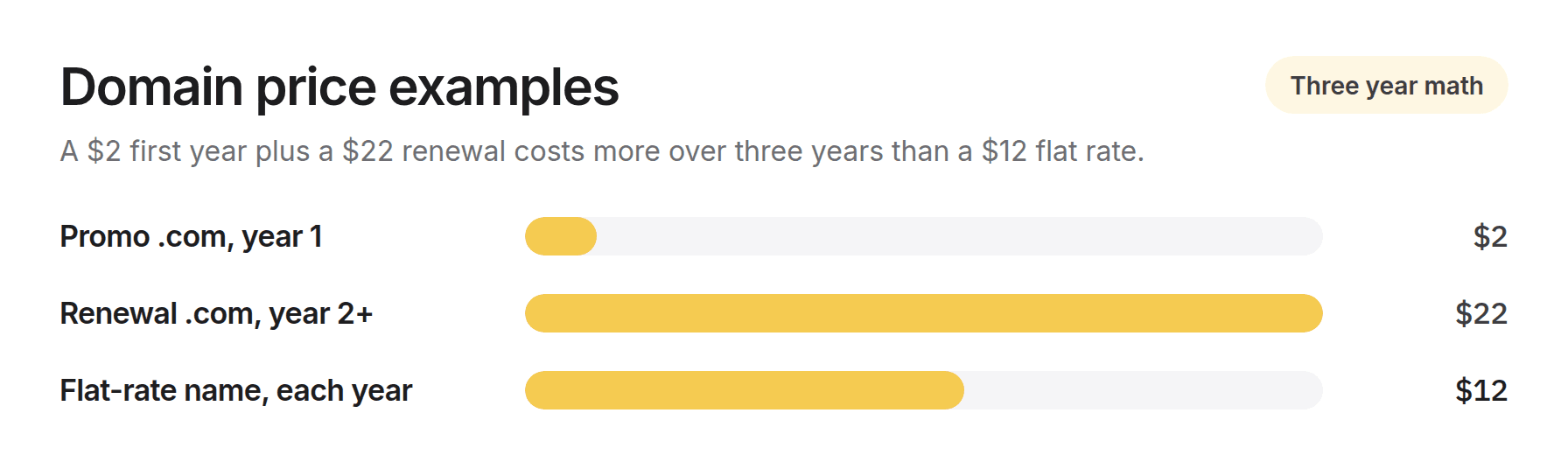
- Compare renewal prices before you look at the year-one sale. A $2 first-year .com that renews at $22 costs more over three years than a $12 flat-rate name with no promo.
- Register extra years when the rate is actually locked. That only helps if the shop guarantees the price, not if it discounts year one and resets later.
- Consider a credible other ending if your ideal .com is taken or priced as premium. A .co, .us, or trade-specific ending can cost less and still read as a business.
- Keep admin control of your email. Confirm you can move the inbox later before you sign up for a bundled mailbox.
- Read the transfer policy before you buy. Some shops add long lock periods. That costs you flexibility even when the sticker looked good.
Set a calendar reminder 60 days before renewal. That gives you time to compare shops if the current one raises the price with little notice.
Once you have put a custom domain on cards, ads, and a Google listing, the name is part of the brand. Turn on billing alerts on day one, not after the first surprise renewal. For the rest of the website budget, see how much a small business website costs in 2026.
What should you check before you buy or renew?
Run this list at checkout, for a new name or a renewal:
- Compare the renewal price across two or three shops. Ignore a cheap sale price if year two is high.
- Confirm whether privacy that hides your address is included for good or only for year one.
- Decide the registration length now, and either turn on auto-renew or set a manual reminder.
- Save the admin login somewhere secure, and turn on two-factor authentication.
- Confirm the name points at the site you want people to open.
- If you are buying a resale name, use escrow and get proof of any traffic claims.
Two habits help after checkout:
- Keep the account email current. Renewal notices and transfer approvals go there.
- Save a screenshot of the renewal terms in case the shop changes them later without a clear notice.
How OnePagey handles the domain, hosting, and launch
Once you know the real cost of a name, the next question is how to get a working page on it. OnePagey builds a one-page site from a plain-English description, and folds domain search, registration, and hosting into the same setup.
That path fits:
- Solo founders launching a first professional page
- Freelancers who need a credible page this week
- Local service providers (contractors, stylists, consultants) who want a page live without a multi-week build
You get one dashboard and one subscription. On Step 1 you enter a business name and a short description. Available .com suggestions show up in the same flow. After you publish, the name is registered in your name while you subscribe. New U.S. owners walking from tax ID to a live address can also use the EIN to .com path.
Get a domain and a live site on one bill
Pay a little more for a shop that publishes a boring, stable renewal price. Save premium purchases for a name you can defend as a brand asset. Control of the name matters more than the cheapest day-one sticker.
OnePagey searches and registers the domain, hosts the page, and launches an editable one-page site from a short business description. Free publishes on a OnePagey address. Annual Standard is $8.25/mo billed $99 with your .com included while you subscribe. Monthly Standard is $9.99/mo. Premium is $12/mo billed $144, or $14.49/mo, and adds business email. Browse real site examples or use cases by business type, then claim a name and preview the page before you pay.
Questions about domains or plans? Visit our support page. Real people reply within one business day.
Frequently Asked Questions
What is a reasonable price for a domain name?
A reasonable price for a standard domain is $10 to $20 per year for most .com, .net, or .org names. Anything advertised well below that is likely a first-year promo, so check the renewal rate before you commit.
How much does a 3-year domain name cost?
Multiply the shop's per-year rate by three. Most charge the same annual price across extra years at checkout. A standard name typically renews at $10 to $20 per year, though some shops give a small multi-year discount.
Why does a $2 domain jump to $20 at renewal?
Shops use a cheap first year to win the checkout, then charge the real yearly rate starting in year two. The 5 to 10x jump is common on promo .com names and on newer endings.
Is it worth paying for a domain name?
Yes, for a business people need to find. A name in your control looks established on cards and invoices, and it is the address you keep if you later switch the site that sits on it.
Can I buy a domain name permanently?
Domain registration is a recurring lease, even at the wholesale level. You can register for up to ten years at once with most shops, and you still renew to keep the name active.
What extra fees show up on a domain bill?
Privacy, email, transfers, a small pass-through fee of about $0.18, and a reclaim fee of $80 to $200 if the name expires. Compare those lines next to the sale price.
How does OnePagey handle domain cost?
Standard and Premium include a .com while you subscribe, so the name and hosting stay on one bill. Free publishes on a OnePagey address. Annual Standard is $8.25/mo billed $99. Premium is $12/mo billed $144 and adds business email.
Keep reading
More guides on getting a small business online.
- Just filed your LLC? Get a .com you can text
Papers are in. People still ask for a link. Get a .com you can text, then put that same address in your bio, Google listing, and cards.
- From EIN to .com: simple path for new US small businesses
EIN in the folder. Next, a .com in your name and one page customers can open. Five steps from tax ID to a link you can text.
- Just formed your LLC? Domain + one-page site checklist
Papers are filed. People still ask for a link. Use this checklist for a .com in your name and a one-page site you can text.
One-page sites by use case
If you already know the kind of work you do, start on a page written for that job.